🦁 Great Barracuda
🧾 Quick Facts
The great barracuda (Sphyraena barracuda) is a fascinating apex predator of the oceanic world. With its sleek and formidable appearance, the great barracuda is often seen gliding through the warm waters of tropical and subtropical regions.
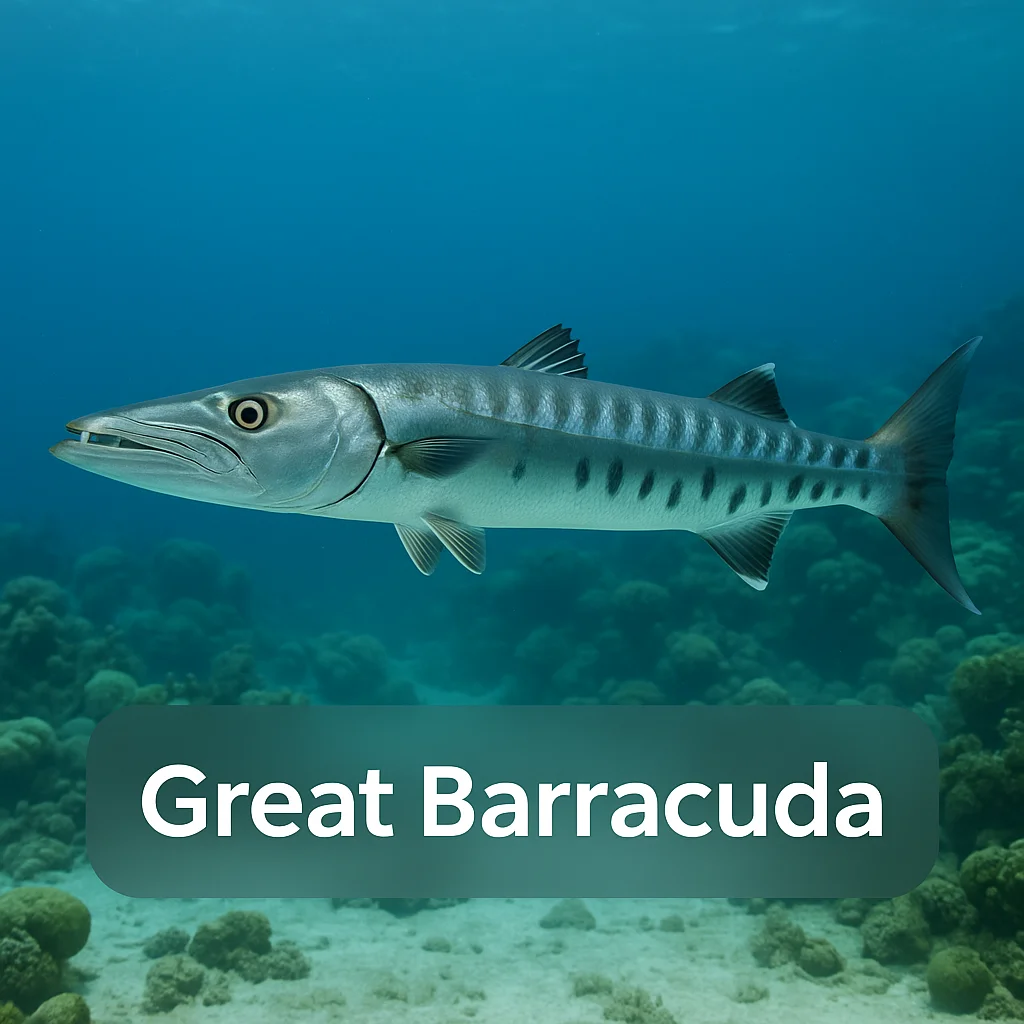
- Common name(s): Great Barracuda
- Scientific name: Sphyraena barracuda
- Animal type: Fish
- Typical adult size: 60–100 cm in length; up to 165 cm for large individuals
- Typical lifespan: 10–15 years in the wild
- Diet type: Carnivore; feeds mainly on smaller fish and cephalopods
- Activity pattern: Primarily diurnal
- Social structure: Mainly solitary, occasionally found in small groups
- Speed / movement highlights: Can swim at speeds of up to 36 km/h
- Intelligence/learning: Known for ambush tactics and calculated hunting strategies
- Primary habitats: Coastal waters, coral reefs, open ocean
- Geographic range: Atlantic Ocean, Indian Ocean, and the Red Sea
- Predators/threats: Larger sharks, human fishing activities
- Conservation status: Varies by region; generally not considered endangered
🔍 Identification & Appearance
The great barracuda is known for its elongated body and fearsome appearance. It has a streamlined, torpedo-shaped body allowing for swift, agile movements in the water.
- Body is long and slender with a pointed head
- Distinctive steel-gray color with a white belly
- Young individuals often display darker spots or barring on their sides
- Prominent, sharp, fang-like teeth
- Easily recognizable large, under-slung lower jaw
- Two dorsal fins with a noticeable gap between them
- Often confused with smaller barracuda species; great barracudas are substantially larger
- Top ID Tips
- Look for the elongated, torpedo-shaped body
- Note the steel-gray coloration
- Check for the fang-like teeth
- Observe the large lower jaw
- Spot the gap between dorsal fins
- Identify by size: larger individuals can be up to 165 cm
- Distinguish from smaller species by more extensive barring in juveniles
🧱 Body Structure & Physical Adaptations
The great barracuda is built for speed and predation in aquatic environments. Its body structure and features have evolved to make it a highly efficient predator of fish and other sea life.
- Streamlined, slender body for rapid swimming
- Massive under-slung jaw equipped with sharp teeth for capturing prey
- Strong pectoral and tail fins for agile maneuvers
- Keen eyesight for detecting prey and predators in clear and murky waters
- Ability to accelerate quickly and ambush prey
- Gills adapted for efficient breathing in oxygen-rich waters
- Developed lateral line system for sensing vibrations
- Key Adaptations
- Efficient structural design for high-speed swimming
- Razor-sharp teeth for grasping slippery prey
- Strong jaw muscles for powerful bites
- Keen visual acuity
- Lateral line for vibration detection
- Effective gill system
- Camouflage capability with background environment
- Rapid acceleration for surprise attacks
🌍 Range & Distribution
The great barracuda is widely distributed across various warm seas, favoring both coastal inlets and deeper offshore waters. They are often found between the depths of the surface and 100 meters.
- Broad geographic distribution: Atlantic Ocean, Indian Ocean, Pacific Ocean, and the Red Sea
- Typically found in tropical and subtropical regions
- Frequently inhabit coral reefs, mangroves, and sea grass beds
- Rarely venture too far from warm water currents
- Some populations exhibit seasonal migrations within their range
- Where You Might Find It
- Along the coasts of Florida
- Caribbean Sea regions
- Near the Great Barrier Reef
- Within the Red Sea coral reefs
- Offshore of Southeast Asia
- In the bays of the Indian Ocean
- Near Central America's eastern shores
- Continental shelf areas with abundant prey
🏞️ Habitat & Shelter
The great barracuda is a versatile species when it comes to habitat selection. It thrives in different marine environments, benefiting from the rich biodiversity and shelter these regions provide.
- Prefers warm coastal areas with abundant food sources
- Often resides near coral reefs, mangroves, and seagrass beds
- Uses reefs as hunting grounds due to high prey concentrations
- Stays in clearer waters for better hunting conditions
- May shift habitats seasonally based on water temperatures and prey movements
- Tends to shelter in rocky crevices or under overhangs during resting periods
🧭 Behavior & Ecology
Although primarily solitary, the behavior of the great barracuda is characterized by its opportunistic hunting strategies and exceptional predatory skills. In addition, it plays a significant role in maintaining the ecological balance within its habitat.
- Daily routine includes hunting primarily during daylight hours
- Resting and conserving energy in sheltered reef areas
- Known for their aggressive feeding and ambush stalking of prey
- Communicates through body language and movement
- Acts as a top predator, controlling populations of smaller fish
- Participates in the reef ecosystem as an apex predator
- Behavior Highlights
- Solitary hunter with occasional small group aggregation
- Utilizes ambush predation techniques
- Exhibits striking speed and agility during hunts
- Infrequent but observable mutualistic relationships with cleaning fish
- Individually distinct hunting patterns and preferences
- Creates balance within reef ecosystems as a predator
👥 Social Life & Group Dynamics
The social structure of the great barracuda is predominantly solitary, though they may associate with others in specific contexts such as juvenile schooling for protection or during abundant feeding opportunities.
- Typically solitary, except during juvenile stages
- Juveniles often form small schools for protection
- Occasional loose groupings during feeding frenzies
- No structured dominance hierarchies observed
- Aggression mainly directed at prey, rarely at conspecifics
- Social Structure Notes
- Solitary lifestyle is predominant
- Juvenile schooling offers protection
- Limited social interaction with mixed groups for feeding
- No complex group structures like packs or prides
- Communal hunting not typical unless prey is plentiful
🍽️ Diet, Prey & Predators
The great barracuda is a formidable carnivore that primarily feeds on a variety of smaller fish, employing skilled hunting techniques to capture its prey. Despite its top predator status, it is not without its own threats.
- Diet consists of smaller fish, squids, and crustaceans
- Employs surprise attacks to capture fast-moving prey
- Main natural predators are larger sharks
- Utilizes teeth to grasp and puncture prey effectively
- Generally avoids humans unless provoked
- Occasional scavenging habits observed in younger individuals
- Feeding Notes
- Carnivorous diet primarily comprising fish and cephalopods
- Master of ambush predation
- Sharp teeth designed for gripping prey tightly
- Young barracudas may scavenge opportunistically
- Retreats when threatened by larger predators like sharks
🦌 Hunting, Foraging & Movement
The great barracuda's prowess in hunting is a result of its adept swimming ability and calculated ambush methods, enabling it to surprise its prey before a swift attack. Its overall movement strategy is dictated by the availability of prey and environmental conditions.
- Primarily an ambush predator, relying on speed for short bursts
- Capable of rapid acceleration and swift direction changes during hunts
- Patrols the shallow waters of reefs and shores for prey
- Occasionally moves to deeper waters depending on the prey
- Relies on eyesight and vibrations to locate prey
- Seasonal movement patterns observed in some populations based on prey availability
- Movement & Strategy
- Swift swimmer with exceptional burst speed
- Relies heavily on ambush attacks
- Predatory skill relies on sight and lateral line sensing
- Targets fish lurk in the reef's crevices
- Utilizes open water speed and agility for hunting
🧠 Intelligence & Senses
The great barracuda possesses a range of specialized senses and cognitive abilities that aid in its survival as a skilled predator. Its predatory tactics are the result of a combination of acute eyesight and keen sense of vibrations in the water.
- Exceptional eyesight to detect movements and contrasts
- Highly developed lateral line system detects vibrations
- Learned hunting skills and familiarization with terrain
- Evidence of problem-solving in unfamiliar situations
- Memory plays a role in frequenting productive hunting zones
- Notable Abilities
- Acute visual acuity for detecting prey
- Lateral line to sense disturbances
- Memory aids repeated hunting success
- Ability to adapt hunting strategies based on environment
- Skilled in exploiting prey-rich habitats
🪺 Reproduction, Pregnancy & Parenting
Reproductive mechanisms of the great barracuda involve external fertilization, with a high egg mortality rate. This reproductive strategy ensures that despite numerous challenges, the species continues to thrive.
- Breeding season often varies by region
- Spawning typically happens in deeper offshore waters
- High volume of eggs released by females
- External fertilization achieved in open water
- Young barracudas start life near shallow waters for protection
- No direct parental care after eggs are laid
- Egg and larval survival is naturally low, but consistent spawning helps offset losses
- Reproduction Snapshot
- Region-based breeding timings
- Spawns in deeper waters
- High number of small eggs per female
- Lacks parental involvement post-spawning
- Eggs hatch into planktonic larvae
♀️♂️ Male vs Female Differences
While there are no highly pronounced differences between male and female great barracudas in terms of appearance, there are subtle distinctions in size and potentially in reproductive cycles.
- Females may grow slightly larger than males
- Size and mass differences more noticeable in mature individuals
- Breeding behavior and role vary slightly between sexes
- Males involved in territorial displays during breeding season
- Sex Differences at a Glance
- Females often larger than males
- Breeding-related behaviors differ
- Males involved in territoriality
- Size variations are subtle
🧬 Subspecies & Variation
The great barracuda is largely homogenous across its range, with little recognized subspecies variation. However, minor differences in color or size among different geographic populations may occur.
- No distinct subspecies widely acknowledged
- Size variation observed depending on regional ecosystem
- Coloration may vary slightly based on habitat conditions
- No significant adaptive or physical differences
- Variation Notes
- Minor variations in size by region
- Potential color shifts based on local habitat
- Subspecies classification remains largely undivided
⚠️ Threats, Conservation & Human Interaction
The great barracuda faces several challenges and pressures from both natural and human factors. Responsible interaction and conservation awareness are essential for its continued coexistence.
- Threats include habitat degradation and overfishing
- Ciguatera poisoning risk from consumption leads to reduced fishing pressures in some areas
- Maintaining balanced ecosystems helps ensure their prey remains plentiful
- Human activity and pollution pose indirect threats
- A necessity for protected marine areas to support biodiversity
- Responsible Notes
- Practice sustainable fishing methods
- Awareness of ecological impact of habitat changes
- Avoid areas with high risks of ciguatera poisoning
- Contribute to marine conservation efforts
- Maintain healthy fish populations and ecosystems
✨ Fun Facts & Unique Traits
- A magnificent and skilled hunter, it patrols marine habitats with precision
- Often misunderstood, barracudas are generally more curious than aggressive towards divers
- Capable of leaping out of the water when hunting schools of baitfish
- Their fearsome reputation has earned them a significant presence in folklore and stories
- Barracudas play a key ecological role by removing weak and injured fish, promoting healthier populations
- Like sharks, they are among the fastest fish in the ocean
- Despite their large size, they can accelerate rapidly to capture prey
- Barracudas have been known to follow divers out of sheer curiosity due to shiny objects
📌 Summary
- The great barracuda is identifiable by its torpedo-shaped body and sharp teeth
- Found in tropical and subtropical oceanic regions worldwide
- Its habitat includes coral reefs and coastal waters
- As a carnivore, it primarily feeds on smaller fish through ambush tactics
- Larger sharks are among its few natural predators
- Typically solitary, though juveniles may form small schools
- Reproduction involves high egg output without parental care
- Key adaptations include rapid acceleration and excellent eyesight
- Recognized for its role as an apex predator in maintaining marine ecosystems