🦁 Sawfish
🧾 Quick Facts
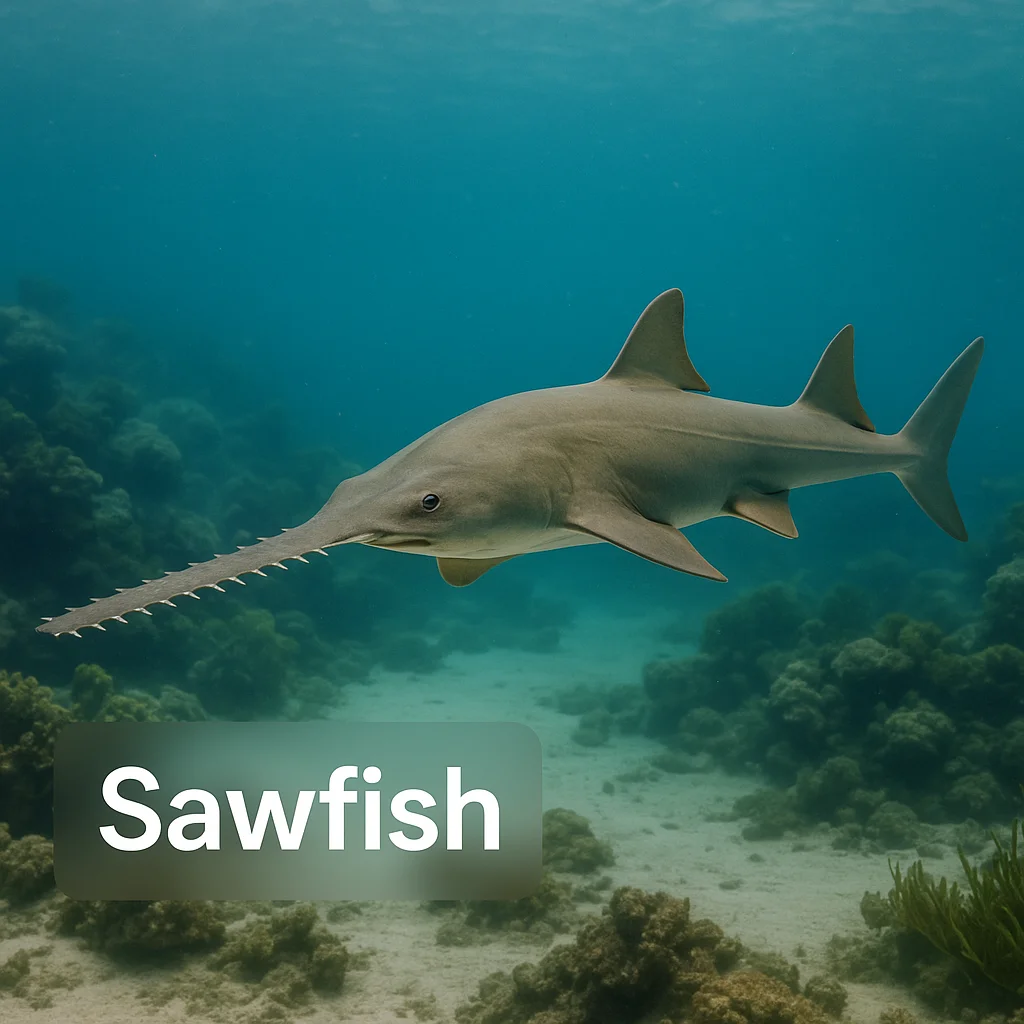
Sawfish are fascinating marine animals known for their unique saw-like rostrum. They are a group of rays related to sharks and are often found in tropical and subtropical waters across the globe.
- Common name(s): Sawfish
- Scientific name: Family Pristidae
- Animal type: Fish (Elasmobranchii subclass)
- Typical adult size: 11–23 feet (3.3–7 meters) in length
- Typical lifespan: 30–50 years
- Diet type: Carnivore; feeds on fish and invertebrates
- Activity pattern: Mostly nocturnal
- Social structure: Mostly solitary
- Speed / movement highlights: Glides gracefully, capable of sudden bursts
- Intelligence/learning: Complex behaviors observed, capable of learning
- Primary habitats: Coastal waters, river mouths, mangroves
- Geographic range: Indo-Pacific, Atlantic Ocean, some river systems
- Predators/threats: Larger sharks, humans
- Conservation status: Critically Endangered (varies by region)
🔍 Identification & Appearance
Sawfish can be recognized by their elongated, flattened bodies and the distinctive, extended rostrum that resembles a saw. Their coloration is usually grayish or brownish on top, with a lighter underside. The rostrum is lined with sharp teeth, and this unique feature is what sets them apart from similar species.
- Top ID Tips:
- Look for a long, saw-like rostrum
- Smooth skin texture without visible scales
- Broad, flattened body shape
- Greyish to brownish coloration
- Large pectoral fins resembling wings
- Whip-like tail without a significant dorsal fin
- Rostrums usually have 24–32 teeth
- Eyes positioned on top of the head
- Often confused with sawsharks, but sawfish are generally larger
🧱 Body Structure & Physical Adaptations
Sawfish display a streamlined and elongated body optimized for navigating dense habitats like mangroves and shallow waters. Their rostrum is not only a sensory organ but also serves as a tool for hunting. They have cartilage-based skeletons, similar to sharks, and possess electro-sensory pores along their rostrum for detecting prey.
- Key Adaptations:
- Elongated rostrum used for sensing and catching prey
- Cartilaginous skeleton for flexibility
- Electro-sensory perception through rostrum
- Large pectoral fins for enhanced maneuverability
- Rostrum aids in disturbing sediment to expose hidden prey
- Advanced sensory pores detect electrical signals from prey
- Rostrum teeth regrow if broken
- Can tolerate both saline and freshwater environments
🌍 Range & Distribution
Sawfish are distributed across tropical and subtropical regions of the world. They are commonly found in coastal areas, river mouths, and occasionally venture into freshwater. Their range includes parts of the Atlantic Ocean, the Indian Ocean, and some Western Pacific Ocean regions.
- Where You Might Find It:
- Coastal regions of the Southeastern United States
- The waters around West Africa
- Mangrove coastlines in Northern Australia
- Some parts of the Red Sea
- Freshwater rivers such as the Amazon
- Estuaries in the Indo-Pacific
- Caribbean Sea and Gulf of Mexico
- Tidal flats and sandy shores
- Tropical river systems globally
🏞️ Habitat & Shelter
Sawfish prefer shallow coastal waters often associated with mangroves, seagrass beds, and muddy bottoms. These habitats provide both shelter and abundant food resources. The structure of mangroves and river systems plays a critical role in their hunting behavior and survival, offering cover from predators and a place to ambush prey.
🧭 Behavior & Ecology
Sawfish are mostly solitary creatures, although they may occasionally gather in groups. They predominantly hunt during the night using their rostrum to detect and dislodge prey. Their main activities consist of hunting for fish and crustaceans, resting in sheltered waters, and migrating along river systems.
- Behavior Highlights:
- Nocturnal hunting activities
- Use of rostrum to swipe and capture prey
- Migratory during certain seasons
- Often found in proximity to or within mangroves
- Able to tolerate both saltwater and freshwater
- Sparsely social, mostly solitary but not highly territorial
- Important predator within their ecosystem
- Interactions with other fish as competitors for prey
- Migh congregate during breeding
👥 Social Life & Group Dynamics
Sawfish are generally solitary but have been occasionally observed in loose groups. They do not form strong social bonds, and their interactions are primarily driven by environmental factors and breeding opportunities. Their solitary nature minimizes competition for limited resources within their habitats.
- Social Structure Notes:
- Mostly solitary lifestyle
- No permanent group structures
- Occasional groupings observed around rich feeding areas
- Transient aggregations noticed during breeding seasons
- Limited observed cooperation among individuals
- No known dominance hierarchies
- Minimal conflict between individuals due to dispersed ranges
- No organized defense strategies observed
- Typical avoidance of other large predators
🍽️ Diet, Prey & Predators
Sawfish primarily feed on fish and crustaceans that inhabit their coastal and riverine environments. They use their rostrum to stir the sediment, uncovering hidden prey. Natural predators include larger sharks and occasionally crocodiles, while humans pose significant threats due to fishing activities.
- Feeding Notes:
- Carnivorous diet focused on fish and crustaceans
- Rostrum used to slash through schools of fish
- Feeds primarily in shallow water environments
- Opportunistic predator
- Prey includes small to medium-sized fish and invertebrates
- No specialized anti-predator defenses besides size and rostrum
- Does not actively scavenge; primarily an active hunter
🦌 Hunting, Foraging & Movement
Sawfish are ambush predators, relying on their stealth and swift movement to capture prey. They use their rostrum to navigate turbid waters and uncover or stun prey hidden beneath the sediment. Typically, they hunt in shallow waters at night and are capable of sudden, short bursts of speed.
- Movement & Strategy:
- Primarily swimmers with strong bursts of speed
- Effective use of rostrum to locate and capture prey
- Nocturnal foraging activities
- Traverse between different water types (fresh and saltwater)
- Seasonal migratory movements along coastlines
- Rostrum enables sweeping movements to dislodge prey
- Skilled at navigating complex environments like mangroves
- Have a defined home range but are not overly territorial
🧠 Intelligence & Senses
Sawfish possess several heightened senses, such as electroreception through their rostrum, which helps detect prey. They show complex behaviors and have adapted well to varying environments, indicating a capacity for learning and problem-solving, particularly in hunting situations.
- Notable Abilities:
- Advanced electro-sensory perception
- Acute sense of smell for locating prey
- Adaptive hunting strategies in different environments
- Capacity to learn from experiences
- Use of rostrum as both sensor and tool
- Limited research on social intelligence
- Navigation through complex coastal habitats
- Ability to detect very small prey through vibration senses
🪺 Reproduction, Pregnancy & Parenting
Sawfish display a variety of reproductive strategies including ovoviviparous behaviors where embryos develop in eggs within the mother's body. They typically have small litters, and the young are born fully formed and independent, with little parental involvement observed after birth.
- Reproduction Snapshot:
- Ovoviviparous reproduction
- Mating often occurs in warmer months
- Gestation can last up to a year
- Shallow coastal areas used as nursery grounds
- Litter size can range from 8 to 20 pups
- Pups born live and fully developed
- No significant parental care post-birth
- Birth occurs in protective environments like mangroves
♀️♂️ Male vs Female Differences
There are subtle differences between male and female sawfish, primarily in size and reproductive organs. Females tend to be slightly larger than males and possess distinguishable structures such as claspers, which are modified pelvic fins in males used during mating.
- Sex Differences at a Glance:
- Females generally larger than males
- Males have claspers for reproduction
- No significant differences in color and pattern
- Females may display bulkier body shape
- Behavioral roles do not significantly differ
- Male claspers located near pelvic fins
- Sexual maturity might vary slightly in age
🧬 Subspecies & Variation
There are several recognized species of sawfish, each exhibiting subtle variations mostly in size, rostrum tooth count, and geographic range. However, due to their endangered status, studies are ongoing to better classify and understand these differences fully.
- Variation Notes:
- Green sawfish (Pristis zijsron)
- Smalltooth sawfish (Pristis pectinata)
- Largetooth sawfish (Pristis pristis)
- Differences in rostrum tooth count
- Varying body sizes based on habitat
- Differences in home range and preferred environments
- Need for further research on genetic diversity
⚠️ Threats, Conservation & Human Interaction
Sawfish face numerous threats, primarily due to habitat destruction and fishing bycatch. They are also targeted for their highly prized rostra and fins. Conservation efforts focus on habitat protection, fishing regulations, and public awareness campaigns to safeguard their populations.
- Responsible Notes:
- Significant threat from coastal development
- Bycatch in commercial fisheries
- Illegal trade of rostra contributes to decline
- Conservation efforts include habitat conservation
- Educating fishermen on safe bycatch release
- Efforts to maintain mangrove and riverine habitats
- Promoting ecotourism to raise awareness
✨ Fun Facts & Unique Traits
- Sawfish rostrum can be up to a quarter of their body length.
- Rostra are so sensitive they can detect heartbeats of prey.
- Sawfish have been around for over 100 million years.
- Despite their fearsome appearance, sawfish pose little threat to humans.
- Ancient cultures revered sawfish, often featuring them in art.
- Sawfish can regenerate their teeth throughout their lives.
- They serve as essential indicators of ecosystem health.
- In some regions, sawfish are culturally significant and feature in local folklore.
📌 Summary
- Sawfish are recognized by their distinct saw-like rostrum.
- They inhabit tropical and subtropical coastal areas and rivers.
- Carnivorous diet, relying on fish and crustaceans.
- Face threats from habitat loss and fishing pressures.
- Mostly solitary with occasional groupings observed.
- Reproduce ovoviviparously, giving birth to live young.
- Adapt to various environments, from saltwater to freshwater.
- Critically Endangered due to human interference and habitat destruction.
- Unique for their electro-sensory perception used in hunting.