🦁 Shortfin Mako Shark
🧾 Quick Facts
The Shortfin Mako Shark, often heralded as the fastest shark in the ocean, is an impressive and dynamic predator known for its speed, power, and intelligence. A member of the mackerel shark family, this species captivates ocean enthusiasts and researchers alike.
- Common name(s): Shortfin Mako Shark, Mako Shark
- Scientific name: Isurus oxyrinchus
- Animal type: Fish
- Typical adult size: 10 to 12 feet in length; 200 to 1,300 pounds
- Typical lifespan: 28 to 35 years in the wild
- Diet type: Carnivore; primarily consumes bony fish and cephalopods
- Activity pattern: Primarily diurnal, some nocturnal activity
- Social structure: Generally solitary
- Speed / movement highlights: Can swim up to 45 mph
- Intelligence/learning: Known for problem-solving ability and learning capacity
- Primary habitats: Open ocean, commonly beyond continental shelves
- Geographic range: Worldwide in temperate and tropical oceans
- Predators/threats: Larger sharks, orcas, human-driven pressures
- Conservation status: Threatened; varies by region
🔍 Identification & Appearance
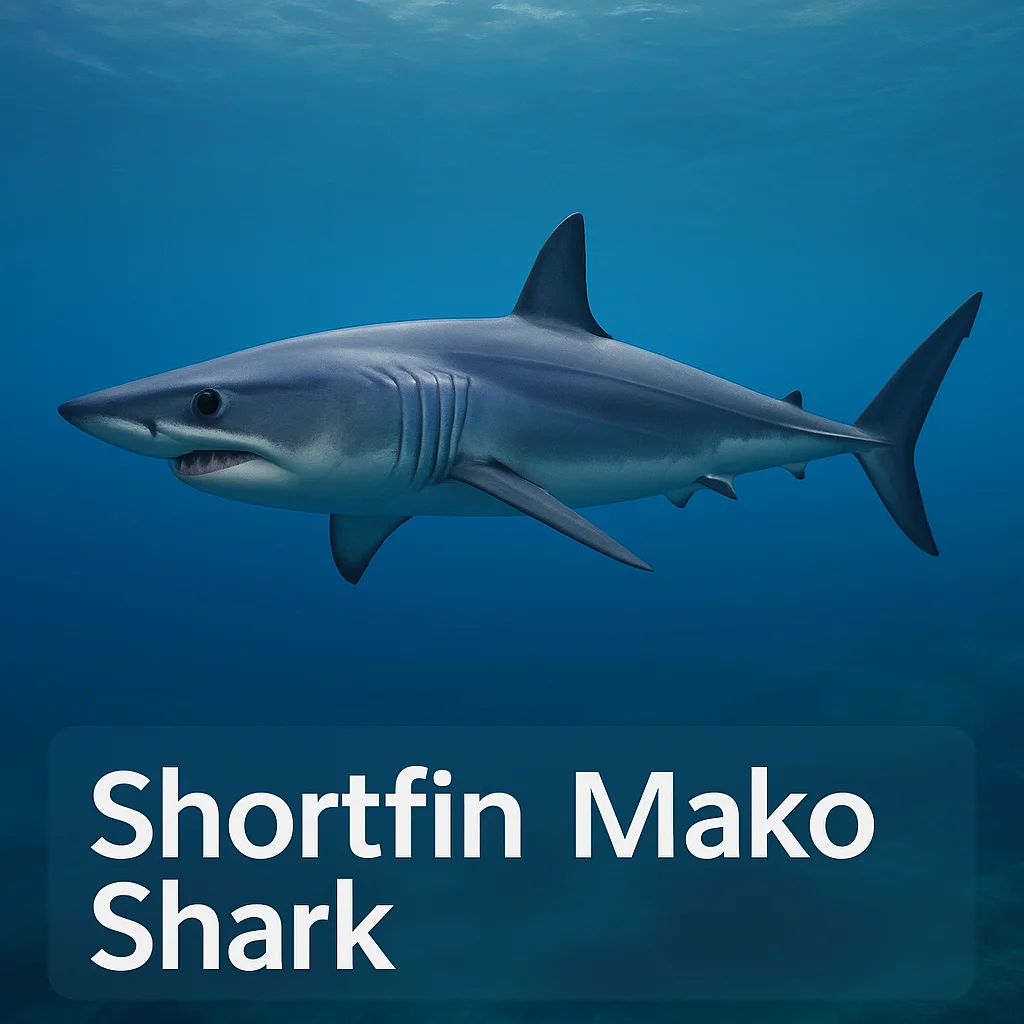
The Shortfin Mako Shark is recognizable for its robust and streamlined body designed for speed. The slender, torpedo-shaped silhouette is accompanied by a conical snout, crescent-shaped caudal (tail) fin, and crescent-shaped pectoral fins.
The upper body is deep blue to metallic blue, blending to a lighter underbelly. Notable characteristics include large, black eyes and sharp, serrated teeth visible even when the mouth is closed. While juveniles might have slightly darker coloration, adults exhibit a more defined pattern.
Tracks and signs, like bite marks on prey and occasional fin sightings, give subtle hints of the presence of makos in ocean environments. Compared to the Longfin Mako, the Shortfin has shorter pectoral fins, which is a key distinguishing feature.
- Slender, torpedo-shaped body
- Conical snout with large black eyes
- Metallic blue upper and light underbelly
- Crescent-shaped caudal fin
- Sharp, visible serrated teeth
- Shorter pectoral fins compared to Longfin Mako
- Metallic sheen unique to its kind
- Blackish tip on dorsal fin, especially in juveniles
- Robust, muscular build optimized for fast swimming
🧱 Body Structure & Physical Adaptations
The Shortfin Mako's body is built for agility and speed. With a streamlined form and powerful musculature, it is optimized for swift swimming. Its torso is sturdy yet aerodynamic.
The shark's teeth are sharp, with a backward curve, aiding in gripping prey firmly. Its eyes are well-adapted for catching light in deep water, supporting visual hunting.
The Shortfin Mako employs its crescent tail fin for propulsion and smaller, pointed pectoral fins for steering. It possesses an acute sense of smell, essential for detecting prey over considerable distances.
- Streamlined, slender body
- V-shaped, pointed tail fin for propulsion
- Serrated teeth adapted for tearing flesh
- Strong olfactory senses
- Acute vision adaptations for deep water
- Powerful, muscular build for superior swimming speed
- Pectoral fins for efficient steering
- Distinctively robust structure for deep-sea hunting
🌍 Range & Distribution
The Shortfin Mako Shark is widely distributed across the globe's temperate and tropical waters, found in numerous oceanic regions. Their presence is notable beyond continental shelves, a testament to their deep-sea adaptability.
Commonly encountered from latitudes of approximately 50° N to 50° S, they exhibit a preference for warmer ocean currents. Remarkably, some have been seen in higher latitudes during seasonal migrations.
- Normally found in temperate and tropical oceans
- Present in Atlantic, Pacific, and Indian Oceans
- Predominantly oceanic, away from coastlines
- Rarely enters coastal waters but favored in some fishing zones
- Encounters reported from Mediterranean Sea
- Known sightings off the west coast of the Americas
- Moderate association with the Gulf Stream
- Can venture into cooler waters during migrations
🏞️ Habitat & Shelter
As inhabitants of the open ocean, Shortfin Makos typically occupy pelagic zones, where they navigate vast blue waters beyond the reach of continental land masses. They prefer regions teeming with abundant prey, often joining migratory movements congruent with their diets.
Lacking traditional shelters like nests or burrows, they rely on the ocean's vastness for refuge, leading a nomadic lifestyle with occasional ventures near seamounts and underwater plateaus.
Understanding habitat is key to appreciating their foraging and migration patterns, typically guided by water temperature and prey availability.
🧭 Behavior & Ecology
Shortfin Makos are predominantly solitary hunters, their existence punctuated by the pursuit of prey like fish and cephalopods. They exhibit patterns of movement adapted to locate food efficiently, which may involve diurnal or nocturnal tactics depending on prey behavior.
Communication happens through body language; however, little is known about detailed interactions. They play a crucial role as predators, regulating prey populations and maintaining oceanic ecological balance.
- Solitary foragers of open waters
- Highly adaptive movement patterns
- Essential apex predator role
- Possible nocturnal hunting tendencies
- Body motion-based communication
- Limited known social interaction
- Infrequent aggression towards other species
👥 Social Life & Group Dynamics
The Shortfin Mako Shark exhibits a predominantly solitary lifestyle. Sightings of group behavior are rare and typically non-structured, as they do not form packs or herds.
The shark's independence in hunting and migration underscores a lifestyle focused on personal survival, showcasing territorial and interactive independence.
- Primarily solitary
- Rare instances of social interactions
- No established dominance hierarchies
- Occasional proximity during feeding but not cooperative
- Lacks group defensive or hunting strategies
🍽️ Diet, Prey & Predators
The Shortfin Mako's diet is strictly carnivorous, focusing on a variety of oceanic bony fish and cephalopods. As skilled hunters, they employ speed and agility to ambush or pursue prey.
Naturally, the Mako has few predators, with larger sharks and orcas posing occasional threats. Human threats include fishing pressure and habitat disturbance. Defense mechanisms include rapid swimming and evasive maneuvers.
- Feeds on fish like tuna and swordfish
- Catches marine mammals occasionally
- May rely on speed for capture
- Avoids predators by rapid escape
- Vulnerable to entanglement in fishing gear
- Occasional scavenging observed
🦌 Hunting, Foraging & Movement
Renowned for its rapid swimming speed, the Shortfin Mako is an agile predator, known for both ambush and active pursuit hunting strategies. They prefer swift movements during attacks to surprise prey.
Travel patterns reflect expansive home ranges rather than defined territories, often guided by seasonal migrations to align with prey abundance.
- Pursuit predator with high-speed attacks
- Capable of breaching for navigation checks
- Uses acute vision for tracking
- Seasonal migration for optimizing hunting areas
- Typically roams wide distances daily
- Speed advantageous for hunting elusive prey
🧠 Intelligence & Senses
The Shortfin Mako exhibits notable problem-solving skills and rapid learning capabilities, often considering environmental cues and prey behavior. Such intelligence supports their hunting strategies.
The sense of smell is remarkably advanced, enabling detection of prey from afar. Vision, particularly suited for the aquatic environment, assists in low-light conditions.
- Skilled problem solvers
- Learns from environmental interactions
- Utilizes acute olfaction for distant prey detection
- Vision adapts well to deep-sea contexts
- Some learning occurs through hunting experience
🪺 Reproduction, Pregnancy & Parenting
In the Shortfin Mako, reproduction involves a likely polyandrous system, although specifics remain unclear. Mating appears sporadic, potentially influenced by water temperature and prey availability.
Gestation is lengthy, amounting to 15 to 18 months, culminating in live birth. Litter sizes can range from four to 25 pups, depending on maternal conditions. Pups are relatively independent at birth.
- Breeds throughout the year with possible peaks
- Offspring birth up to 18 months post-conception
- Pupping occurs in warmer waters
- Pups are precocial at birth
- Females move to birthing sites in isolation
♀️♂️ Male vs Female Differences
Males and females are of similar shape but can be distinguished by certain size variations, with females generally being larger. Sexual dimorphism is not as pronounced as in other species.
- Females are larger on average than males
- Males possess claspers for mating
- Females have a thicker body girth
- Larger females aid in live-bearance
- Size difference may influence habitat use
🧬 Subspecies & Variation
The Shortfin Mako does not have officially recognized subspecies, but regional differences in size and behavior suggest some ecological variations. These adaptations often result from environmental pressures such as water temperature and prey types in different geographic ranges.
- Size variations occur in different oceanic regions
- Behavioral differences noted in feeding habits
- Region-specific adaptations seen in physical structure
- Migratory patterns can vary by ocean basin
- No formal subspecies classification at present
⚠️ Threats, Conservation & Human Interaction
The Shortfin Mako faces numerous threats, both natural and anthropogenic. Overfishing, bycatch, and habitat degradation pose significant risks. Its speed and hunting capabilities, once safeguards, are no match for modern fishing technologies.
Efforts to conserve the species center around sustainable fishing practices and protecting key habitats. Ethical practices in research and aquariums are vital for a balanced existence.
- Threatened by overfishing and sport fishing
- Bycatch mortality in commercial fisheries
- Pollution affecting prey abundance
- Conservation efforts require international collaboration
- Encouragement of ecosystem-based management
✨ Fun Facts & Unique Traits
- Considered the fastest shark, capable of speeds up to 45 mph
- Known to leap out of the water, a behavior called "breaching"
- Has the ability to elevate body temperature, increasing muscle efficiency
- Symbols of agility and power in maritime cultures
- Frequently studied for its sleek hydrodynamic form
- Notorious for lengthy migrations between feeding grounds
- Displays remarkable acceleration during short pursuits
- The subject of various oceanic legends due to its speed
- Preys on species that migrate, adapting its diet to oceanic availability
📌 Summary
- Streamlined body and blue coloration
- Global distribution in temperate and tropical oceans
- Predominantly solitary, adept hunter
- Carnivorous diet focused on fish and cephalopods
- Few natural predators, though human threats are significant
- Lacks complex social structure, generally loners
- Long gestation period with live birth
- Adapts to various oceanic conditions for survival
- Recognized for its unmatched swimming speed