🦈 Swordfish
🧾 Quick Facts
The Swordfish, known for its distinctive elongated, sword-like bill, is a remarkable predator of the ocean. Here are some key facts about this fascinating species:
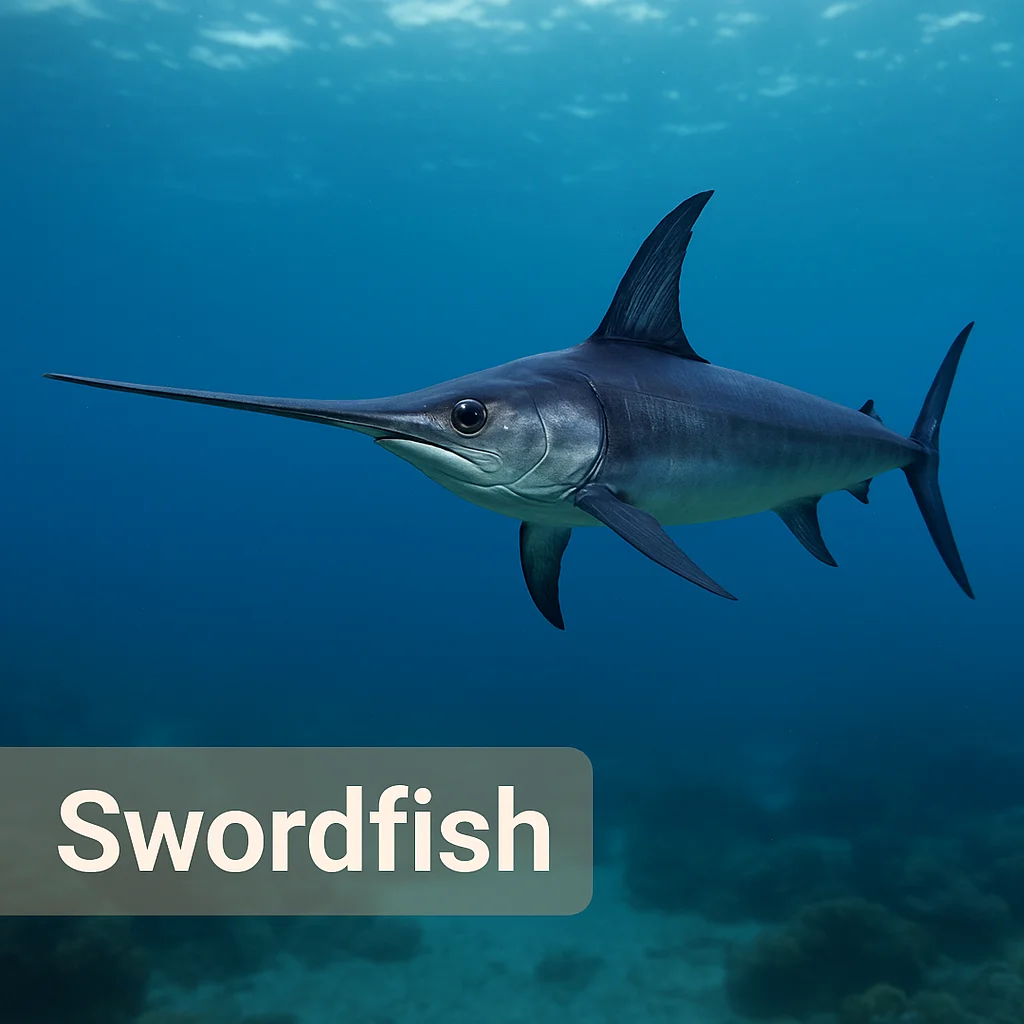
- Common name(s): Swordfish
- Scientific name: Xiphias gladius
- Animal type: Fish
- Typical adult size: 9 - 15 feet (length), up to 1,400 pounds
- Typical lifespan: 9 - 15 years in the wild
- Diet type: Carnivore, primarily feeding on fish and squid
- Activity pattern: Mostly nocturnal
- Social structure: Solitary
- Speed / movement highlights: Can reach speeds of up to 60 mph
- Primary habitats: Open ocean and deep sea
- Geographic range: Worldwide in temperate and tropical oceans
- Predators/threats: Sharks, larger predatory fish, humans
- Conservation status: Varies by region, generally not endangered
🔍 Identification & Appearance
The Swordfish is easily identifiable by its large, elongated body and distinctive bill or "sword." Its body is smooth and streamlined, designed for speed. Typically, swordfish are dark blue or black on the upper side and light underneath, aiding camouflage from predators and prey alike.
- Top ID Tips:
- Elongated, sword-like bill
- Sleek, torpedo-shaped body
- Dark blue to black back and silver underbelly
- Large dorsal fin, located far forward
- Lacks scales in adults
- No teeth; relies on the bill for hunting
- Single keel on each side of the body near the tail
- Juveniles have small spines that are lost as they mature
🧱 Body Structure & Physical Adaptations
The Swordfish has adapted impressively to its pelagic lifestyle. Built for speed, its long, slender body and powerful tail fin enable swift swimming and agile maneuvers. The lack of scales reduces drag, and the keel aids in stabilizing during rapid movements.
- Key Adaptations:
- Elongated bill used to slash and stun prey
- Sleek, streamlined body for high-speed swimming
- Powerful tail fin for propulsion
- Large eyes optimize low-light vision for deep water hunting
- Lacks traditional detectable scales, enhancing speed
- Gills capable of extracting oxygen efficiently in low-oxygen waters
- Highly developed circulatory system maintains muscle temperature
- Pectoral fins aid in steering
🌍 Range & Distribution
Swordfish are found in oceans worldwide, primarily in temperate and tropical regions. They prefer open sea environments and are known to traverse great distances, including across the Atlantic or Pacific Oceans.
- Where You Might Find It:
- Atlantic Ocean
- Pacific Ocean
- Indian Ocean
- Mediterranean Sea
- Coastal waters of North and South America
- Offshore waters near Australia and New Zealand
- Open sea areas near Japan
- Warm waters near the Gulf of Mexico
🏞️ Habitat & Shelter
Swordfish thrive in open ocean environments where they have ample room to roam and hunt. Their habitat is generally away from coastal regions, but they can sometimes be found near the continental shelf edges. Temperature plays a critical role in their habitat preference, often leading them to follow warmer water currents for hunting and breeding.
🧭 Behavior & Ecology
Swordfish are mostly nocturnal predators, hunting near the surface at night and returning to deeper waters during the day. They use their long bills with snappy sideway swings to injure prey, primarily targeting schools of fish and squid. Swordfish play a vital ecological role as apex predators, controlling the population of various fish species and maintaining a balanced marine ecosystem.
- Behavior Highlights:
- Solitary by nature, except during breeding
- Migratory, following ocean currents
- Predatory, using speed and the bill to catch prey
- More active at night when hunting
- Participates in vertical migration, ascending at night
- Can dive to depths of 2,000 feet
- Localized populations may have distinct migration patterns
- Do not form schools, unlike some other predatory fish
👥 Social Life & Group Dynamics
Swordfish are predominantly solitary and do not exhibit complex social structures like schooling fish. Social interactions are generally limited to brief encounters during mating periods. Females often produce large quantities of eggs, which they broadcast in open waters, minimizing the need for pairing or social bonds.
- Social Structure Notes:
- Typically solitary
- Limited social interaction
- Briefly pair during the breeding season
- Lacks social hierarchies
- No coordinated hunting with other swordfish
- Seasonal congregation possible in breeding areas
🍽️ Diet, Prey & Predators
Swordfish are carnivorous, primarily feeding on pelagic fish such as mackerel, barracudas, and smaller tuna, as well as squid. They use their formidable speed and agility, combined with their sword-like bill, to slash at and stun prey. Despite being top predators, swordfish face threats from larger sharks and killer whales, and human fishing practices.
- Feeding Notes:
- Consumes a wide variety of pelagic fish
- Females eat more than males
- Slashes prey with bills before consumption
- Feeding primarily at night at the water surface
- Prefers prey 6 inches to 2 feet in size
- Squid is a key dietary component
- Flexible diet adjusts to prey availability
- Rarely scavenges, but will not pass an opportunity
🦌 Hunting, Foraging & Movement
Swordfish are known for their remarkable speed and agility in the open ocean. They exhibit a powerful swimming style propelled by their strong tail fins. During foraging, they tend to hunt near the surface at night, plunging back to deeper, cold waters during daytime. They may undergo considerable migratory journeys in line with prey movements and breeding needs.
- Movement & Strategy:
- High-speed swimming in open waters
- Slashes prey using its bill
- Nocturnal surface hunting
- Vertical migrations for temperature balance
- Migrates over long distances seasonally
- Agile in open oceans, avoiding obstacles
- Predation relies on stealth and bursts of speed
- Pursues schools of fish with vertical slashes of the bill
🧠 Intelligence & Senses
Despite their lack of tools or manipulative features, swordfish display keen sensory abilities. Their large eyes are adapted for excellent vision in dimly lit, deeper waters, facilitating nighttime hunting. Limited research is available on their cognitive abilities or intelligence, focusing mainly on their ecological roles and physiological adaptations.
- Notable Abilities:
- Exceptional vision in low-light conditions
- Adapted gills for extracting oxygen efficiently
- Hunting involves quick, calculated movements
- Utilizes body heat regulation for deeper dives
- Responsive navigation skills in open sea
- Minimal vocalizations known
- Limited direct human studies on intelligence
🪺 Reproduction, Pregnancy & Parenting
Swordfish are believed to spawn in warmer waters, with females capable of releasing millions of eggs during a single spawn. The fertilized eggs float freely in the ocean until they hatch, and young swordfish grow rapidly. There is no parental care, as the wide dispersal of eggs reduces the chance of predation.
- Reproduction Snapshot:
- Spawning typically in warmer waters
- Females release large numbers of eggs
- Eggs hatch without parental care
- Breeding season varies with location
- Spawning happens in summer and autumn months
- Rapid growth rate in early life stages
- Short period from egg to juvenile independence
♀️♂️ Male vs Female Differences
In swordfish, females are generally larger than males, a typical trait among many large fish species. This size difference can directly influence behavior, reproductive roles, and energy requirements. However, sword lengths in relation to body size do not significantly differ between genders.
- Sex Differences at a Glance:
- Females larger than males
- Both sexes have similarly proportioned swords
- Females eat more to support larger body size
- No distinct coloration differences
- Similar behavior aside breeding size
- Breeding season sees females more invested
🧬 Subspecies & Variation
There is currently no scientifically accepted division of subspecies within the swordfish population. However, regional variations are noted in size and reproductive patterns, largely attributed to environmental conditions. Swordfish in warmer waters tend to grow faster and reproduce more frequently.
- Variation Notes:
- No recognized subspecies
- Size can vary by region
- Faster growth in warmer regions
- No significant color variations noted
- Reproductive timing varies globally
- Adaptability to different temperature ranges
⚠️ Threats, Conservation & Human Interaction
Swordfish face several threats primarily from overfishing and bycatch. Human fishing activities greatly impact their populations, with conservation efforts under various international regulations aiming to manage and monitor fishing activities to ensure sustainable swordfish populations. As popular targets for sport fishing and consumption, responsible fishing practices are encouraged.
- Responsible Notes:
- Vulnerable to overfishing
- Bycatch poses significant risks
- International quotas in place for sustainable fishing
- Important as sport fish
- Conservation status varies in different regions
- Vital research data being gathered continuously
- Bioaccumulation makes them susceptible to pollution impacts
✨ Fun Facts & Unique Traits
- The swordfish’s bill is not used for stabbing as commonly believed, but for slashing at prey.
- They are one of the fastest swimmers in the ocean, reaching speeds of up to 60 mph.
- Swordfish can heat their eyes and brain, improving vision in cold, deep water.
- Capable of diving more than 2,000 feet in search of prey.
- Due to their solitary nature, swordfish travel the ocean alone, only congregating in specific breeding areas.
- Despite similarities, swordfish and marlins are distinct species, each with different ecologies.
- Their lack of true scales is an adaptation to open ocean life, reducing friction as they swim.
📌 Summary
- Sleek, powerful predators known for their sword-like bills
- Occupy warm, open oceans worldwide
- Carnivorous with a diet of fish and squid
- Main predators include sharks and large marine animals
- Mostly solitary, exhibiting solitary hunting strategies
- Breeds in warmer waters without parental involvement
- Adapted with exceptional speed and vision
- Face threats from overfishing and bycatch
- Play a crucial role as apex predators in marine ecosystems