🦁 Beaver
🧾 Quick Facts
Beavers are fascinating, semi-aquatic mammals known for their remarkable engineering skills in building dams, canals, and lodges. They are important ecosystem engineers, influencing their habitats significantly through their activities.
- Common name(s): Beaver
- Scientific name: Castor canadensis (North American beaver), Castor fiber (Eurasian beaver)
- Animal type: Mammal
- Typical adult size: 3 to 4 feet long including the tail, 40 to 70 pounds
- Typical lifespan: 10 to 20 years in the wild
- Diet type: Herbivore; primarily feeds on bark, twigs, leaves, and aquatic plants
- Activity pattern: Mostly nocturnal
- Social structure: Family groups, often referred to as colonies
- Speed / movement highlights: Capable swimmer with webbed hind feet
- Intelligence/learning: Skillful builders and knowledgeable of hydrology principles
- Primary habitats: Freshwater rivers, streams, ponds, and lakes
- Geographic range: North America, Europe, and parts of Asia
- Predators/threats: Wolves, coyotes, bears, and human-induced habitat changes
- Conservation status: Varies by region; generally stable but some populations are threatened
🔍 Identification & Appearance
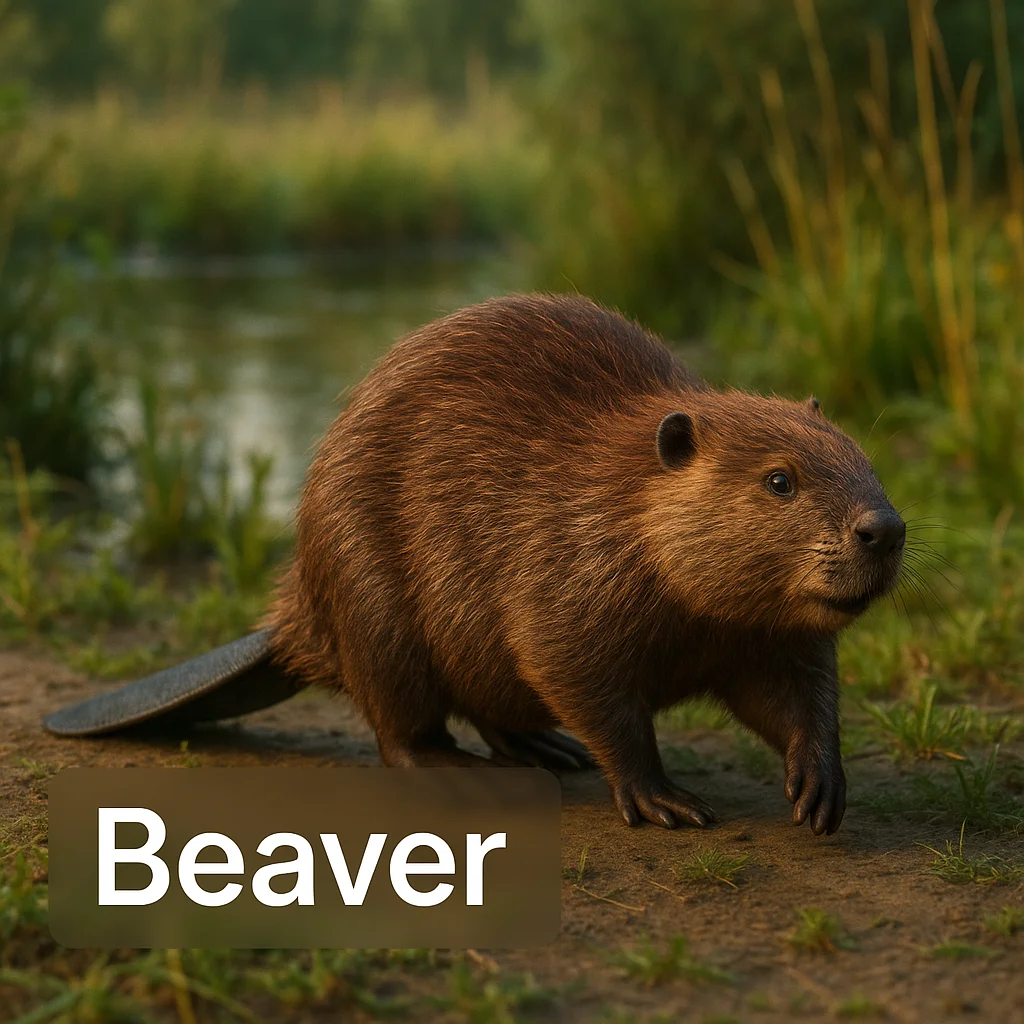
Beavers are easily recognized by their robust bodies and distinctive features that suit their aquatic lifestyle. They have strong, webbed hind feet and a broad, flat, scaly tail. Their bodies are covered in dense fur, which can be predominantly brown with slight variations.
- Sturdy, stocky silhouette with a broad, flat tail
- Dense, water-repellent fur, generally brownish in color
- Large, orange incisors for gnawing wood
- Small facial features with small eyes and rounded ears
- Tracks feature webbed hind feet with five toes
- Scat is cylindrical and woody, often found near feeding sites
- Compare with muskrats: beavers are larger with more prominent tails
- Winter fur is denser and darker compared to summer
- Top ID Tips:
- Look for rounded, sturdy bodies
- Identify the signature flat, paddle-like tail
- Notice the prominent orange teeth
- Spot the distinctive webbed hind feet
- Check for signs of gnawed trees near water
- Observe their lodge and dam constructions
🧱 Body Structure & Physical Adaptations
Beavers are superbly adapted to their semi-aquatic lifestyles with unique physical characteristics that enhance their ability to build, swim, and survive in various habitats.
- Compact, sturdy bodies designed for powerful swimming
- Webbed hind feet for effective propulsion in water
- Strong forelimbs and large incisors for cutting wood and building
- Specially adapted jaw muscles allow for impressive bite force
- Thick fur provides insulation in cold water
- Keen sense of smell and hearing for environmental awareness
- Nictitating membranes protect eyes while swimming
- Sealed ears and nostrils to prevent water entry when submerged
- Key Adaptations:
- Waterproof fur and protective membranes
- Strong, webbed hind feet for swimming
- Powerful incisors for constructing dams
- Stable, flat tail for effective propulsion
- Effective jaw and muscle structures for biting
🌍 Range & Distribution
Beavers are broadly distributed across the northern hemisphere. They inhabit various freshwater bodies across North America, Europe, and extending into some parts of Asia. Their range depends significantly on the availability of water and suitable wood sources.
- Primarily found in North America and particularly common in the United States and Canada
- Eurasian beavers occur more scattered throughout Europe and parts of Asia
- Prefers lowland water systems, but can be found at various elevations
- No significant migrations; generally resident throughout the year
- Occasionally expanding range due to successful reintroduction efforts
- Where You Might Find It:
- Beaver ponds and altered waterways
- Temperate forests with ample water sources
- Streams and lakes rich in aquatic vegetation
- Lower valleys and plains with tree cover
- Rehabilitated regions following conservation projects
🏞️ Habitat & Shelter
Beavers thrive in freshwater habitats where they can harvest wood and construct their renowned lodges and dams. They make ponds by damming rivers or streams, which creates the still water they prefer. Their lodges, made of sticks and mud, provide shelter and a dry living space during winter.
- Wetlands and riparian zones adjacent to rivers and streams
- Lodges provide dry, protected areas for family groups
- Canals are dug by beavers to transport building materials and food
- Modified landscapes offer critical habitat for themselves and other species
- Seasonal behavior includes increased building activity to prepare for winter
🧭 Behavior & Ecology
Beavers are active mostly at night and dusk when they engage in their classic dam and lodge building activities. They are territorial and use scent markings to convey territorial boundaries. Through their environmental modifications, beavers create ecosystems that support diverse plants and wildlife.
- Busy builders; construct dams and lodges and modify habitat
- Influence water flow and storage through ecosystem engineering
- Communicate with vocalizations and scent markings using castoreum
- Provide habitat for other species by altering landscapes
- Primarily nocturnal, becoming active at dusk
- Regularly groom to maintain waterproof fur
- Clear trails from water to food sources
- Behavior Highlights:
- Recognized for their impressive dam-building skills
- Observed felling trees with strong incisors
- Scent marking is vital for territoriality
- Constructive force in creating wetland environments
- Active mostly during nighttime hours
👥 Social Life & Group Dynamics
Beavers typically live in family units known as colonies, comprising a monogamous breeding pair and their offspring from different years. These structures illustrate cooperative behaviors in maintenance tasks like dam building and resource gathering.
- Family-based groups centered around a monogamous pair
- Group size varies but often includes several offspring
- Young may stay with parents for up to two years
- Cooperative behaviors seen in group tasks like maintaining and extending dams
- Conflict is minimal within groups due to clear roles
- Social Structure Notes:
- Colony structure involves extended families
- Parents and older offspring often seen working together
- Strong territorial instincts within family groups
- Young remain within family until mature enough to establish own territories
🍽️ Diet, Prey & Predators
Beavers are herbivorous, primarily consuming the bark and cambium of trees such as aspen, willow, birch, and maple. In the warm months, they also eat aquatic plants and fresh leaves. Predation pressures include several large carnivores, but they are adept at avoiding danger by utilizing their waterways.
- Diets mainly consist of woody and aquatic vegetation
- Make use of winter food caches stored in pond mud
- Capable of felling trees to gain access to branches and leaves
- Hydrodynamic bodies help evade predators like wolves
- Bank burrows and lodges provide refuges against predators
- Feeding Notes:
- Primary food includes tree bark, leaves, and water plants
- Utilize felled trees for sustained winter food supplies
- Construct underwater food caches for winter
🦌 Hunting, Foraging & Movement
Beavers rely on their powerful aquatic mobility to forage for food and gather materials. Their movement is efficient in both water and modestly on land, making them adept at accessing a diverse range of habitat features.
- Efficient swimmers assisted by webbed hind feet
- Slow clumsy movement on land but agile in water
- Construct extensive waterways for transporting materials
- Primarily forage during dusk and nighttime
- Can reduce oxygen needs underwater, supporting long dives
- Movement & Strategy:
- Swimming propelled by webbed hind feet
- Use of tail for balance during land foraging
- Activity centered around dam maintenance and resource gathering
🧠 Intelligence & Senses
Beavers demonstrate considerable problem-solving capabilities, particularly in their construction endeavors. They use their senses efficiently for both foraging tactics and awareness of potential threats.
- Highly intelligent, particularly in environmental modification
- Displays capabilities in spatial awareness to navigate aquatic systems
- Possess acute hearing; rely on sound for environmental awareness
- Keen observational abilities for selecting optimal construction sites
- Notable Abilities:
- Exhibit engineering and problem-solving skills
- Sensitive hearing aids in detecting predators
- Utilize specific trees for optimal food storage
- Adept at creating functional waterways
🪺 Reproduction, Pregnancy & Parenting
Beavers are monogamous and raise their young in family units. Breeding generally occurs during late winter, with young born fully furred and open-eyed in the spring when resources are more abundant.
- Breeding usually occurs from January to March
- Gestation lasts around 100 days
- Typically produce a litter of 2 to 4 kits
- Kits are born well-developed, able to move and see soon after birth
- Both parents involved in caring for young within lodges
- Reproduction Snapshot:
- Breeds primarily during late winter months
- Young beavers, or kits, stay with family for up to two years
♀️♂️ Male vs Female Differences
Beavers exhibit subtle differences between sexes, with both male and female beavers sharing similar roles within the family group. Any size differences are typically negligible and not immediately visible.
- Minimal sexual dimorphism; size and appearance are similar
- Roles in dam-building and colony maintenance are shared
- Both contribute to raising young within shared habitat structures
- Sex Differences at a Glance:
- Similar size and build with no prominent external differences
- Cooperative roles shared between males and females
🧬 Subspecies & Variation
Beavers show limited subspecies differentiation, though geographic populations may exhibit behavioral and environmental differences. Variations can occur according to habitat type and resources available.
- North American beaver (C. canadensis) and Eurasian beaver (C. fiber) are distinct but very similar
- Potential for regional adaptations in terms of behavior and resource use
- Variation Notes:
- Two recognized species, otherwise minimal subspecies classification
⚠️ Threats, Conservation & Human Interaction
While beaver populations are largely stable, habitat loss and water pollution pose ongoing challenges. Conservation efforts have aided in their reintroduction to areas where they were previously extirpated. Coexisting with beavers involves understanding their ecological significance and limiting harmful human impacts.
- Habitat destruction and water pollution pose significant threats
- Successful reintroduction efforts have bolstered populations
- Active management can support habitat restoration and biodiversity
- Responsible Notes:
- Be aware of beaver impact on water systems and land usage
- Conservation benefits reflect increased biodiversity in beaver habitats
✨ Fun Facts & Unique Traits
- Beavers can stay underwater for up to 15 minutes due to a slowed heart rate
- They possess special castor glands that aid in waterproofing fur and marking territory
- Beaver dams can be hundreds of meters long
- Their powerful teeth continuously grow due to their constant use
- Beavers have a unique ear structure that closes when submerged
- Canal digging enhances wood and food transportation efficiency
📌 Summary
- Beavers are recognized for their solid, stocky build and distinctive flat tails
- Inhabit freshwater streams and lakes in North America and parts of Europe and Asia
- Herbivorous, consuming tree bark and aquatic vegetation
- Key species in ecosystem engineering through dam and lodge construction
- Social groups centered around family units
- Moderate predators include wolves and bears
- Distinct for their building activities and influence on ecosystem dynamics