🦁 Chinchilla
🧾 Quick Facts
Chinchillas are small, nocturnal rodents native to the Andes mountains in South America. With their soft, dense fur and playful nature, chinchillas have become popular pets around the world, though they are also critical members of their natural ecosystem.
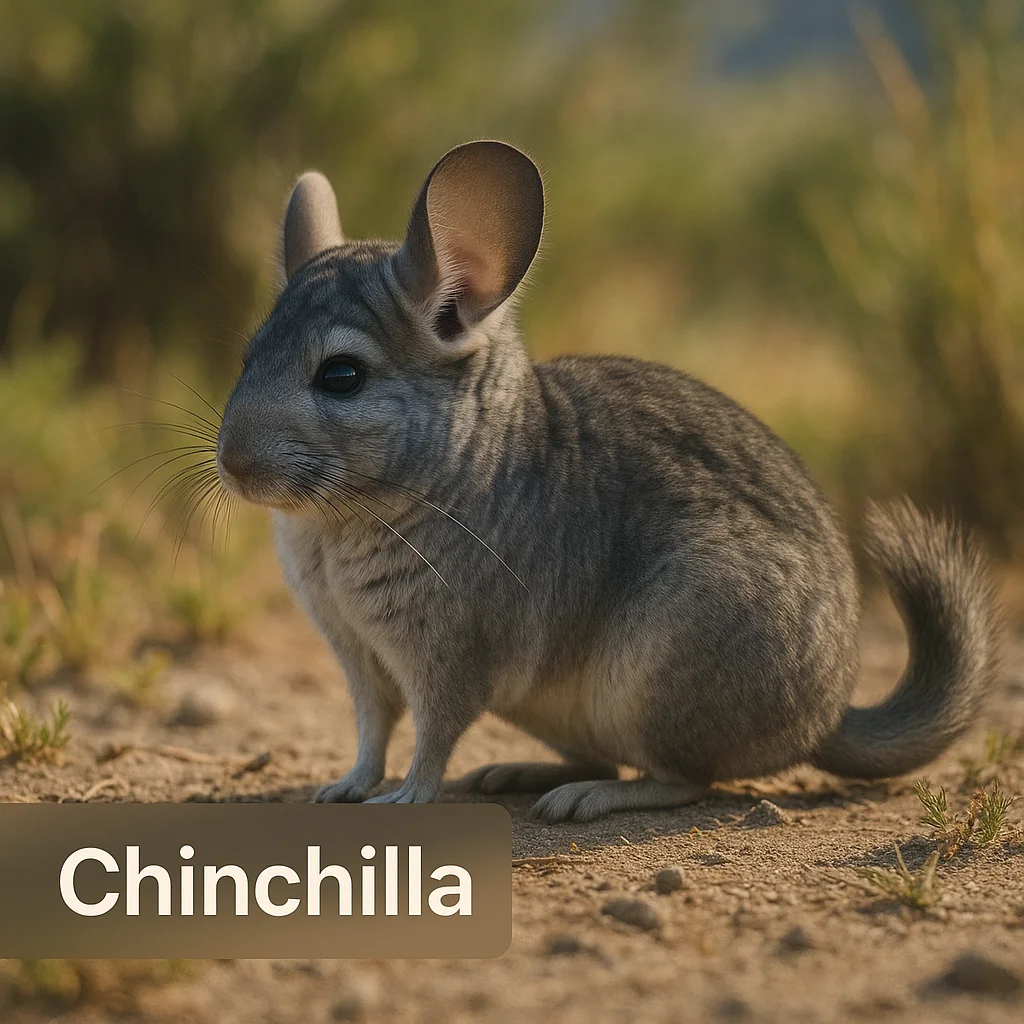
- Common name(s): Chinchilla
- Scientific name: Chinchilla lanigera, Chinchilla chinchilla
- Animal type: Mammal
- Typical adult size: 23-38 cm (9-15 inches) long; tail adds an additional 10-15 cm (4-6 inches), approximately 500-800 grams (1.1-1.8 lbs)
- Typical lifespan: 10-20 years in captivity; typically shorter in the wild
- Diet type: Herbivore; grasses, leaves, bark, seeds
- Activity pattern: Nocturnal
- Social structure: Group-oriented; often found in colonies
- Speed / movement highlights: Agile jumpers; can leap five feet vertically
- Intelligence/learning: Exhibits curiosity and ability to learn from interactions
- Primary habitats: Mountainous, rocky areas
- Geographic range: Andes Mountains, primarily Chile and Peru
- Predators/threats: Birds of prey, foxes; primarily habitat loss and hunting by humans
- Conservation status: Endangered
🔍 Identification & Appearance
Chinchillas are easily recognized for their dense, soft fur and compact bodies. Their dense fur can have various shades of grey, often with a bluish tint. They have large ears and bushy tails that help in balance while climbing rocky surfaces. Chinchillas also sport large, expressive eyes that contribute to their sensitive vision.
- Top ID Tips:
- Compact, rounded body shape with dense fur
- Large, thin ears and sensitive whiskers
- Bushy tail and large hind legs adapted for jumping
- Typically bluish-grey coat color but can vary
- Large, reflecting eyes adapted for nocturnal vision
- Distinguishable by their continuously growing front teeth
- Look-alikes: Similar to ground squirrels but with denser fur
- Field signs: Droppings are small, rounded pellets
- Tracks: Jumping gait often leaves irregular tracks
🧱 Body Structure & Physical Adaptations
Chinchillas have evolved to thrive in rocky, mountainous terrains. Their robust hind legs and flexible spines make them excellent jumpers and climbers. Their dense fur provides insulation against cold temperatures, a necessity in their natural high-altitude habitats. Sharp claws help with climbing and digging into rocky crevices.
- Key Adaptations:
- Powerful hind legs and flexible spine for jumping
- Densely packed fur for high-altitude cold resistance
- Sharp, ever-growing teeth tailored for gnawing on plants
- Large, sensitive ears for detecting predators
- Acute vision suited for low light conditions
- Claws adapted for gripping rocky surfaces
- Sensitive vibrissae (whiskers) aid in navigation
🌍 Range & Distribution
Chinchillas inhabit the Andes Mountains, primarily in Chile and Peru, although historical records indicate a broader range in South America. They are found in arid, rocky environments at elevations of 3,000 to 5,000 meters (9,800 to 16,400 feet). Their distribution is highly fragmented and influenced by hunting and habitat destruction.
- Where You Might Find It:
- Andes mountains, primarily in Chile and southern Peru
- High-altitude rocky outcrops
- Scrubland with sparse vegetation
- Regions with crevices for shelter
- Elevations ranging from 3,000 to 5,000 meters
- Occasionally on cliff faces
- Rarely below 3,000 meters unless in captivity
- Prefers steep, desolate landscapes
🏞️ Habitat & Shelter
Chinchillas prefer rocky, mountainous terrains with sparse vegetation, where they can graze and hide from predators. They often seek shelter in natural crevices and burrows but are also known to utilize burrows made by other animals. Their habitat preference offers protection from climatic extremes and predation, playing a vital role in their survival.
🧭 Behavior & Ecology
Chinchillas are mostly active during the night, using their time to forage for food and interact with colony members. Communication occurs through a series of vocalizations and body language, helping them maintain social bonds and evade threats. They play a role as grazers in their ecosystem, aiding in the dispersal of plant seeds.
- Behavior Highlights:
- Nocturnal activity pattern
- Tendency to form colonies or small groups
- Vocal and non-vocal communication forms
- Use dust baths to maintain fur condition
- Social grooming observed within group settings
- Forages for a variety of vegetation and seeds
- Role as prey for larger carnivores
👥 Social Life & Group Dynamics
Chinchillas are social animals that commonly form small colonies for protection and social interaction. Within these groups, cooperative care of offspring is not uncommon, and complex social hierarchies may develop. Conflict is typically resolved through vocalizations and displays rather than physical altercations.
- Social Structure Notes:
- Group oriented, often living in colonies
- Social behaviors include mutual grooming
- Warning calls serve as an anti-predator strategy
- Keep inter-individual distance but are not solitary
- Cooperative care occasionally observed
- Dominance displays involve vocalizations
🍽️ Diet, Prey & Predators
Chinchillas are herbivores that rely on a diet of grasses, seeds, and leaves. As they forage nightly, they meticulously choose parts of plants that are high in nutrients. Their natural predators include birds of prey and small mammals, which they evade using agility and timely warning calls. Chinchillas employ their acute hearing and jumping ability to escape threats.
- Feeding Notes:
- Herbivorous diet mainly consisting of grasses
- Seasonal variation in food preference
- Seeds and leaves supplement their diet
- Rich in fiber to accommodate digestive needs
- Main predators include birds of prey and foxes
- Typically feed at night to avoid predators
- Anti-predator behaviors include hiding and swift running
🦌 Hunting, Foraging & Movement
As consummate foragers, chinchillas employ their agility for navigating rocky terrains, primarily foraging under the cover of darkness. They leap vertically to access selections of plants and seeds, using memory of their landscape to revisit fruitful areas. They are adept at finding food sources in seemingly barren environments.
- Movement & Strategy:
- Leaps that exceed five feet in height
- Uses crevices and rocks for concealment
- Forages primarily at night
- Exhibits spatial memory to locate food
- Quick sprints to retreat from predators
- Maintains a home range rather than territorial
🧠 Intelligence & Senses
Chinchillas display signs of intelligence through their strong memory and problem-solving abilities. They have acute senses that allow them to detect subtle environmental cues, essential for avoiding predators and finding food. Research into their cognitive capabilities shows that they can learn routine tasks and exhibit curiosity in new environments.
- Notable Abilities:
- Curiosity-driven exploration behavior
- Good memory supports foraging efficiency
- Acute hearing aids in predator detection
- Sensitive whiskers for detecting environmental changes
- Low-light vision honed for nocturnal activities
🪺 Reproduction, Pregnancy & Parenting
Chinchillas have a gestation period that ranges from 111 to 128 days, typical for such a small rodent. They usually give birth to litters of 1 to 4 fully furred, precocial young, who are cared for by their mother. Breeding is typically seasonal, influenced by environmental conditions.
- Reproduction Snapshot:
- Breeding primarily occurs in spring
- Mating system is often monogamous
- Gestation lasts about 111-128 days
- Typically 1-4 offspring per litter
- Young are precocial at birth
- Mothers provide primary care
♀️♂️ Male vs Female Differences
Sexual dimorphism in chinchillas is minor, with males and females having similar coloration and sizes, although females tend to be slightly larger in some populations. Behaviorally, females can be more dominant during mating, while males might participate in territorial displays.
- Sex Differences at a Glance:
- Females are marginally larger than males
- Minimal differences in coloration
- Females may show dominant behavior
- Similar roles in daily activities
- Males more active in territorial behaviors
🧬 Subspecies & Variation
There are two main species of chinchillas, Chinchilla lanigera and Chinchilla chinchilla, with slight variations in size and habitat preferences. While some researchers propose subspecies based on geographic location, these classifications are subject to ongoing debate.
- Variation Notes:
- Chinchilla lanigera has a longer tail and larger ears
- Chinchilla chinchilla is bulkier and has a shorter tail
- Coat colors vary with environment
- Debate exists on subspecies classification
⚠️ Threats, Conservation & Human Interaction
Natural habitat loss, hunting, and the pet trade pose significant threats to chinchillas. Efforts are being made to conserve remaining populations through protective legislation and habitat restoration. They thrive in community-driven conservation areas. While popular as pets, keeping them requires specialized care to meet their environmental and social needs responsibly.
- Responsible Notes:
- Habitat destruction due to mining and agriculture
- Endangered status underlines need for conservation
- Pet trade requires ethical operations
- Community conservation programs underway
- Education on species' needs can aid protection
✨ Fun Facts & Unique Traits
- Chinchillas have the densest fur of any land mammal!
- They take dust baths, rather than water baths, to maintain their fur.
- Chinchilla lanigera can jump over six feet in a single leap!
- Their teeth grow continuously and need constant gnawing to remain manageable.
- Chinchillas can live up to 20 years, significantly longer than most other rodents.
- Due to their nocturnal nature, they have extraordinary night vision capabilities.
- Chinchillas once roamed a more extensive area but are now limited to isolated pockets.
📌 Summary
- Chinchillas are small mammals recognized by their dense, soft fur and large ears.
- They are native to the Andes Mountains, preferring rocky, arid regions.
- Herbivorous, they feed on a variety of grasses, seeds, and leaves.
- Experience threats from predation, habitat loss, and human exploitation.
- Live in colonies and communicate through vocalizations and grooming.
- Breeding occurs mainly in spring with small litters of precocial young.
- They exhibit strong memory and sensory adaptations for survival.
- Two main species show slight variations influenced by geography and environment.