🦁 European Rabbit
🧾 Quick Facts
The European Rabbit, known scientifically as Oryctolagus cuniculus, is a well-known species of rabbit that has colonized a large part of the globe beyond its native range. This adaptable mammal is important both ecologically and culturally, serving as a key species in many ecosystems and as a common character in folklore.
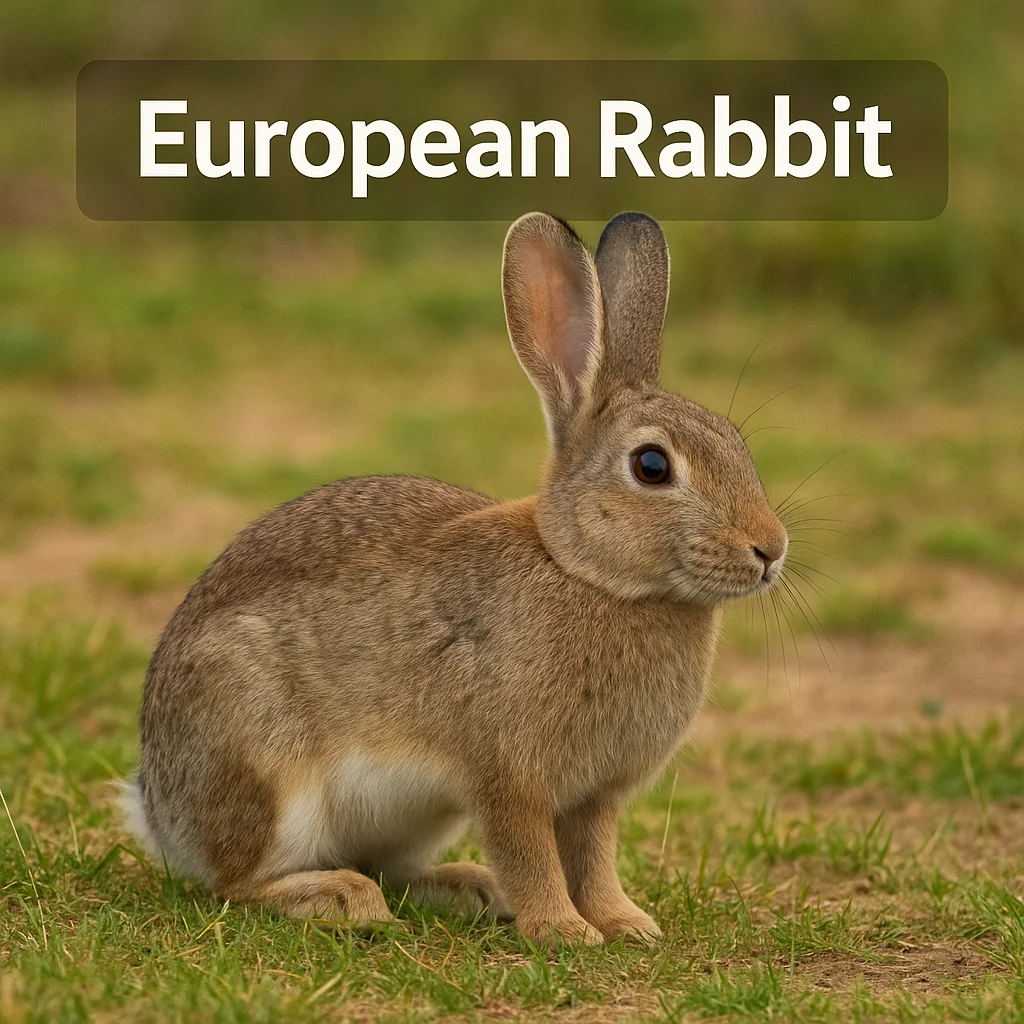
- Common name(s): European Rabbit, Common Rabbit
- Scientific name: Oryctolagus cuniculus
- Animal type: Mammal
- Typical adult size: 34–45 cm (length), 1.2–2 kg (weight)
- Typical lifespan: 3–10 years (wild), up to 12 years (captive)
- Diet type: Herbivore; grasses, herbs, vegetables
- Activity pattern: Crepuscular
- Social structure: Group (colony)
- Speed / movement highlights: Capable of speeds up to 35 km/h
- Intelligence/learning: Known for complex social behaviors and problem-solving abilities
- Primary habitats: Meadows, woodland edges, grasslands
- Geographic range: Originally from the Iberian Peninsula; introduced worldwide
- Predators/threats: Foxes, birds of prey, feral cats; habitat destruction by humans
- Conservation status: Near Threatened in the wild (varies by region)
🔍 Identification & Appearance
The European Rabbit has a compact, rounded body with strong hind legs that are longer than the forelimbs, facilitating rapid movement. They are typically grayish-brown in color, although variations exist, with white undersides and a distinctive fluffy white tail. Their ears are moderately long, pointy, and sensitive to sound.
- Body shape: Compact, round-bodied with long hind legs
- Coloration: Generally grayish-brown with white highlights
- Distinctive features: Long ears and a white "cotton-tail"
- Tracks/scat: Typically round droppings and well-beaten paths in grass
- Look-alikes: Can be confused with hares; hares are typically larger with longer ears
- Compact body with rounded features
- Grayish-brown fur with white belly
- Fluffy white tail
- Long, slender ears
- Round droppings as field signs
- Distinct from larger hares
- Commonly seen in grasslands
- Crepuscular activity patterns
🧱 Body Structure & Physical Adaptations
European Rabbits are built for speed and agility, with long hind legs that propel them quickly across the ground. Their incisors grow continuously, adapted for a diet of tough, fibrous vegetation. The structure of their ears provides acute hearing, an advantage in avoiding predators.
- Stocky, powerful build
- Continuous growing incisors
- Strong hind legs for rapid movement
- Keen sense of hearing
- Vision optimized for detecting movement
- Adapted for grazing
- Effective predator evasion
- Acute smell for locating food
- Curved claws for burrowing
🌍 Range & Distribution
Originally from the Iberian Peninsula, the European Rabbit has been introduced to numerous regions worldwide, including Australia and New Zealand, where they have at times become invasive. They thrive in temperate zones and are absent only from Antarctica.
- Native to Iberia
- Found in Europe, Australia, New Zealand
- Absent from extremely cold regions
- Adapted to temperate climates
- Populations found in grasslands, forests
🏞️ Habitat & Shelter
The European Rabbit prefers environments where they can both graze and take cover, such as meadows, grasslands, and open woodlands. They live in burrow systems known as warrens, which provide protection from predators and harsh weather. Seasonal changes affect their activity levels, particularly in harsher climates.
Understanding the rabbit's habitat preferences helps explain its behaviors and survival tactics, such as burrow construction and foraging patterns.
🧭 Behavior & Ecology
European Rabbits are primarily crepuscular, being most active at dawn and dusk. Within their colony, individuals engage in social grooming and establish territories through scent marking. They play an essential role in ecosystems as seed dispersers and as prey for a variety of predators.
- Crepuscular activity patterns
- Complex social interactions
- Scent marking for territory
- Grazers influencing plant composition
- Prey for various predators
- Essential in seed dispersal
👥 Social Life & Group Dynamics
European Rabbits are social animals living in groups, typically organized into colonies or warrens. These structures provide a basis for complex social interactions, cooperation, and hierarchies. Dominance is established through displays and minor skirmishes, ensuring access to resources.
- Live in colonies
- Social grooming is common
- Established dominance hierarchies
- Cooperation in predator vigilance
- Minor conflicts for resource access
🍽️ Diet, Prey & Predators
The European Rabbit feeds primarily on grasses, herbs, and other vegetation. They are key prey for many carnivores, including foxes, birds of prey, and feral cats. To evade predators, they rely on speed and a network of burrows as protective hideaways.
- Herbivorous diet
- Feeds on grasses and herbs
- Prey for multiple predator species
- Uses speed for evasion
- Hides in burrows
🦌 Hunting, Foraging & Movement
As grazers, European Rabbits primarily forage during crepuscular hours. They rely on keen senses of smell and hearing to locate food and detect danger. Capable of bursts of speed, their movement is characterized by a high sprint speed and efficient leaping ability.
- Forage during twilight
- High sprint speeds
- Utilize leaping to escape
- Navigate through scent trails
- Establish home ranges
🧠 Intelligence & Senses
Known for their problem-solving skills and social learning, European Rabbits use their acute senses to navigate their environment. Their vision excels in detecting movement, while their hearing helps alert them to predators. Research on their cognitive abilities varies, often focusing on their social interactions.
- Problem-solving skills
- Use social learning
- Vision detects movements
- Hearing alerts to threats
- Smell aids in foraging
🪺 Reproduction, Pregnancy & Parenting
The breeding habits of European Rabbits are characterized by a highly productive reproductive cycle, with multiple litters possible annually. Gestation lasts about 30 days, with litter sizes ranging from 3 to 7 kits, that are altricial at birth but grow rapidly. Parenting is largely the responsibility of the female.
- Breeding year-round
- Gestation around 30 days
- Litter sizes of 3 to 7 kits
- Female-dominated parenting
- Rapidly growing young
♀️♂️ Male vs Female Differences
Physical differences between male and female European Rabbits are subtle, primarily involving size and behavior. Males tend to be slightly larger and more territorial, engaging in behaviors such as chin marking to establish dominance.
- Males slightly larger
- More territorial males
- Females prioritize parenting
- Chin marking by males
🧬 Subspecies & Variation
European Rabbits exhibit some regional variations, with adaptations related to climate and habitat disparities. These include differences in size and fur color among populations adapted to different environments. Subspecies classification can vary and is often debated among experts.
- Regional size variations
- Fur color adaptations
- Adaptation to local climates
- Subspecies classification debated
⚠️ Threats, Conservation & Human Interaction
The European Rabbit faces a range of threats including habitat loss and disease. Human intervention, such as the introduction of predators and habitat modification, poses additional challenges. Conservation efforts focus on sustaining wild populations and mitigating impacts in areas where they are invasive.
- Threatened by habitat loss
- Diseases such as myxomatosis
- Introduced predators
- Invasive in some regions
- Conservation varies by region
✨ Fun Facts & Unique Traits
- European Rabbits can jump up to 1 meter high
- They are portrayed in various mythologies and folklore
- Have an extraordinary ability to quickly reproduce
- Their burrows can form extensive warren systems
- Important in soil aeration through their digging habits
- High density populations can cause ecological impacts
- Have been an economic resource for fur and meat
- Show complex social behaviors and hierarchies
📌 Summary
- Identified by their compact bodies and long ears
- Common in grasslands and open woodlands
- Introduction across many countries beyond their native range
- Herbivorous, feeding mainly on grasses and herbs
- Preyed upon by a range of carnivores
- Complex social structures within colonies
- Rapid reproductive cycles with multiple litters annually
- Adapted for speed and evasion with strong hind limbs
- Faces various conservation challenges, especially in native areas