🦁 Naked Mole-rat
🧾 Quick Facts
The Naked Mole-rat is a unique and fascinating creature, often inspiring curiosity due to its distinct appearance and remarkable adaptations. Known for its hairless and wrinkled skin, this small rodent is a marvel of nature, surviving in harsh environments with a highly social colony structure.
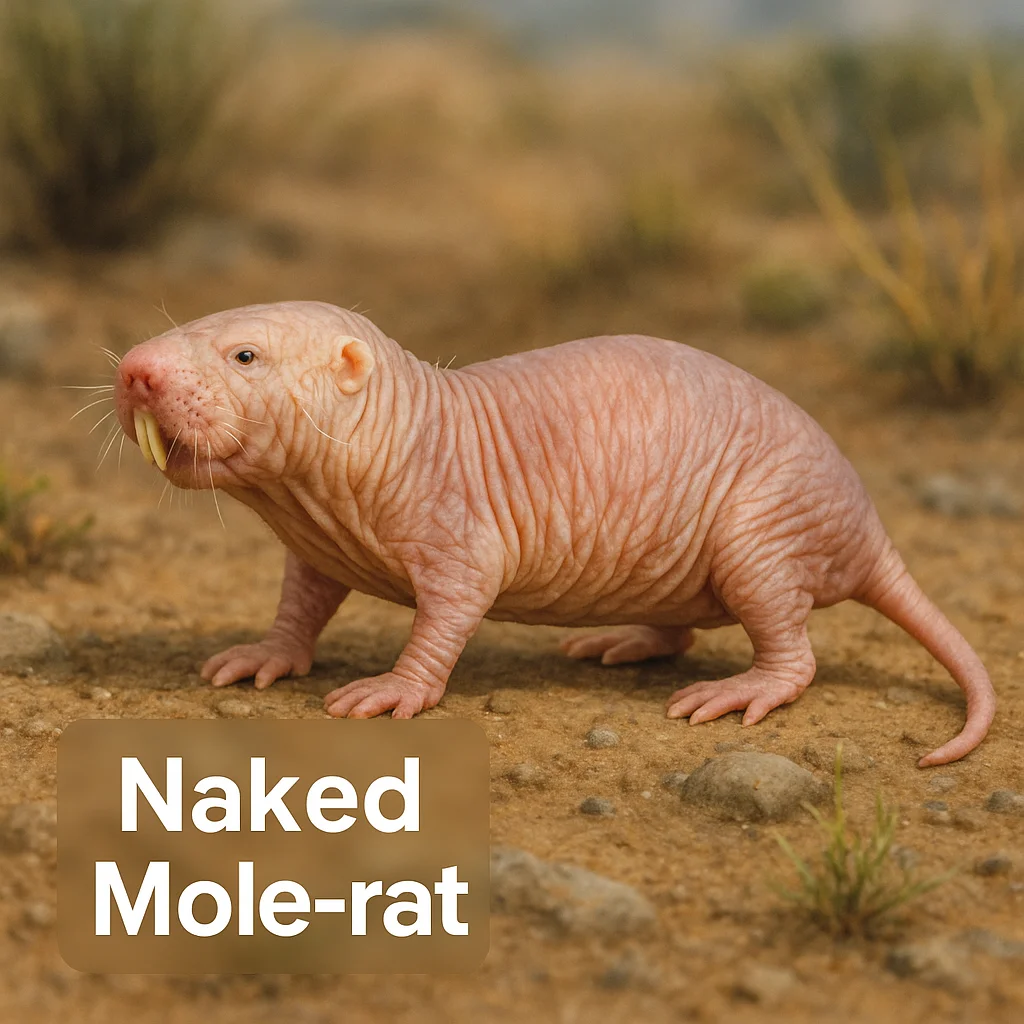
- Common name(s): Naked Mole-rat
- Scientific name: Heterocephalus glaber
- Animal type: Mammal
- Typical adult size: 8-10 cm in length, 30-35 grams in weight
- Typical lifespan: Up to 30 years in captivity; often shorter in the wild
- Diet type: Herbivore; primarily consumes underground tubers and roots
- Activity pattern: Primarily nocturnal
- Social structure: Highly social; lives in colonies with a queen system
- Speed / movement highlights: Built for burrowing rather than speed
- Intelligence/learning: Demonstrates complex social behaviors
- Primary habitats: Subterranean in arid and semi-arid regions
- Geographic range: Eastern Africa, notably Ethiopia, Kenya, and Somalia
- Predators/threats: Snakes, birds of prey; habitat disturbance by humans
- Conservation status: Least Concern, but localized threats exist
🔍 Identification & Appearance
The Naked Mole-rat is easily identifiable with its cylindrical, hairless body, large protruding incisors, and small, almost invisible eyes. Their skin is yellowish-pink, with a lack of external ears, giving them a distinctive appearance compared to other rodents.
- Top ID Tips
- Hairless, wrinkled skin with a pale pink hue
- Elongated body shape with short limbs
- Large, visible incisors protruding from the mouth
- Small eyes set back into the skull
- No external ear flaps, giving a streamlined look
- Short, paddle-like tail
- Continuously growing teeth used for digging
- Tend to stay underground, so tracks are rarely evident
🧱 Body Structure & Physical Adaptations
Naked Mole-rats have a slender, tube-like body adapted for an underground lifestyle. They feature powerful, continuously growing incisors for digging, and their limbs are short but strong for efficient burrowing. Despite small eyes, their sense of touch is highly developed, assisting in navigation through dark tunnels.
- Key Adaptations
- Reduced fur and metabolism for living in low-oxygen environments
- Teeth extruded outward to dig without ingesting soil
- Wrinkled skin allows flexibility and protection from tunnel abrasion
- Vibrissae (whiskers) highly sensitive to changes in the environment
- Vision primarily used for detecting light, not detailed imaging
- Efficient kidney function for water conservation
🌍 Range & Distribution
Naked Mole-rats are native to the dry regions of East Africa, where they live predominantly beneath the surface in intricate tunnel systems. They have adapted exceptionally well to fluctuating environmental conditions prevalent in these areas.
- Where You Might Find It
- Ethiopia’s dry grasslands
- Kenya’s semi-arid regions
- Somalia’s arid regions
- Sparsely vegetated savannas
- Below-ground in vast burrow systems
🏞️ Habitat & Shelter
Naked Mole-rats prefer underground habitats, creating extensive burrow systems that can stretch for miles. These burrows serve as homes, protection from predators, and storage facilities for food. Burrow systems maintain stable temperature and humidity, crucial for climate regulation in their arid environments.
🧭 Behavior & Ecology
Naked Mole-rats adhere to a regimented daily schedule structured around colony needs. Within their societies, they exhibit division of labor, including workers, soldiers, and queens. They communicate through vocalizations and tactile interactions, essential for maintaining social structure and coordination.
- Behavior Highlights
- Can spend their entire lives underground without seeing sunlight
- Communicate through a variety of vocalizations
- Use their strong incisors for excavation and defense
- Explore their environment by tactile navigation
- Role specialization with distinct work roles within a colony
- Exhibit grooming behaviors as part of social bonding
👥 Social Life & Group Dynamics
Naked Mole-rats are eusocial animals, one of the very few mammalian species with such a structure. Colonies consist of a single breeding queen and a few kings, while the rest act as workers or soldiers. Harmony within the colony is achieved through the enforcement of social hierarchies, where cooperative behaviors are critical for survival.
- Social Structure Notes
- Highly organized colony with one reproductive queen
- Worker mole-rats maintain tunnels and gather food
- Soldier mole-rats protect the colony from threats
- Queen is the largest mole-rat, producing and caring for offspring
- Hierarchy driven by pheromonal signals
- Disputes over dominance managed through behavioral displays
🍽️ Diet, Prey & Predators
The Naked Mole-rat primarily subsists on underground plant parts, including tubers which provide not only sustenance but moisture required for survival without direct water intake. Antipredator strategies involve retreating into complex burrow systems, effectively evading most surface dwellers.
- Feeding Notes
- Consumes mainly tubers, roots, and underground bulbs
- Utilizes incisors to strip and consume plant materials
- Chewing reserves moisture, essential in arid climates
- Can feed on a single large tuber for months, due to large size
- Retreat into protected burrow zones when predators like snakes approach
- Mainly forages and eats during low surface activity times
🦌 Hunting, Foraging & Movement
Naked Mole-rats are proficient burrowers, moving through their subterranean environments with ease. They exhibit efficient searching techniques when foraging, enabling the conservation of energy in nutrient-scarce habitats.
- Movement & Strategy
- Burrows through soil with powerful incisors
- Makes shallow tunnels for foraging expeditions
- Utilizes a systematic approach to locating food
- Maintains a large home range with prophylactic trails
- Generally remains within established colony borders
🧠 Intelligence & Senses
Naked Mole-rats exhibit remarkable social intelligence, coordinating complex colony tasks. Their limited vision is compensated by enhanced tactile and auditory senses, useful for communication and environmental awareness essential in pitch-dark tunnels.
- Notable Abilities
- Demonstrates social coordination and problem-solving abilities
- Uses sound cues effectively for coordination
- Sensitive whiskers assist in tactile exploration
- Communicates threats through warning vocalizations
- Research on cognition suggests complex neural responses
🪺 Reproduction, Pregnancy & Parenting
Reproduction within the Naked Mole-rat colony is strictly the realm of the queen, who monopolizes breeding. She produces litters of pups after a gestation period focused on maximizing colony health and future workforce needs.
- Reproduction Snapshot
- Queen mates with a few select males (kings)
- Gestation lasts approximately 70 days
- Litter size can range from 3 to 12 pups
- Pups are born altricial, requiring care
- Workers assist in feeding and caring for young
- Reproductive suppression in non-breeding members
♀️♂️ Male vs Female Differences
Males and females in Naked Mole-rat populations show sexual dimorphism primarily through the role rather than substantial size variations, although queens are notably larger than other colony members.
- Sex Differences at a Glance
- Queens are significantly larger than non-reproductive females
- Minimal size difference observed among workers
- Role differentiation evident in breeding capability
- Males and females can share environmental tasks
- Queen undergoes physical changes to accommodate reproduction
🧬 Subspecies & Variation
Variations within Naked Mole-rat populations are not officially recognized as subspecies. However, environmental discrepancies and colony isolations can lead to minor phenotypic and behavioral variations.
- Variation Notes
- Local adaptations in diet and behavior
- Body size and social roles can vary by region
- Potential for genetic divergency in isolated colonies
- Subspecies classification is not well-supported
⚠️ Threats, Conservation & Human Interaction
Naked Mole-rats benefit from a stable conservation status, though localized threats such as habitat destruction persist. Careful balance is required in habitat management to avoid unintended disturbances to their subterranean ecosystems.
- Responsible Notes
- Vulnerable to habitat degradation and environmental shifts
- Careful land-use practices can mitigate habitat loss
- Resilient but sensitive to rapid agricultural expansion
- Knowledge of burrow locations helps in avoiding accidental destruction
- Zoos contribute to understanding biology through ethical care
✨ Fun Facts & Unique Traits
- Naked Mole-rats can survive oxygen deprivation by switching bodily processes
- Their skin lacks primary pain receptors, unusual for mammals
- Colony roles are comparable to eusocial insects
- Known for exceptional longevity for a rodent of their size
- Help maintain genetic diversity through occasional male dispersal
- Rank among the few mammals exhibiting true eusociality
📌 Summary
- Identified by their pink, hairless, cylindrical bodies
- Native to Eastern Africa's underground habitats
- Eats primarily roots and tubers for nutrition and moisture
- Preyed upon primarily by snakes and large birds
- Exhibit a hierarchy-based social structure with queens and workers
- Reproduction confined to a singular queen per colony
- Adapted to underground life with reduced visual capabilities
- Extraordinary adaptations for harsh environments and social complexity