🦁 Porcupine
🧾 Quick Facts
Porcupines are fascinating rodents known for their sharp quills and distinctive body shape. They are part of a diverse group of species with variations in habitat and behavior across different regions worldwide.
- Common name(s): Porcupine
- Scientific name: Often listed as Hystricidae and Erethizontidae depending on the species
- Animal type: Mammal
- Typical adult size: 60-90 cm in length, weight varies by species (5-16 kg)
- Typical lifespan: 5-10 years in the wild, up to 20 years in captivity
- Diet type: Herbivore; primarily eats leaves, twigs, and bark
- Activity pattern: Primarily nocturnal
- Social structure: Solitary
- Speed / movement highlights: Slow-moving creatures with strong climbing abilities
- Intelligence/learning: Solitary and self-sufficient, capable of learning and adapting to environments
- Primary habitats: Forests, deserts, grasslands, and rocky regions
- Geographic range: North America, South America, Africa, and Asia
- Predators/threats: Predation by large cats, birds of prey, and human interference
- Conservation status: Varies by region
🔍 Identification & Appearance
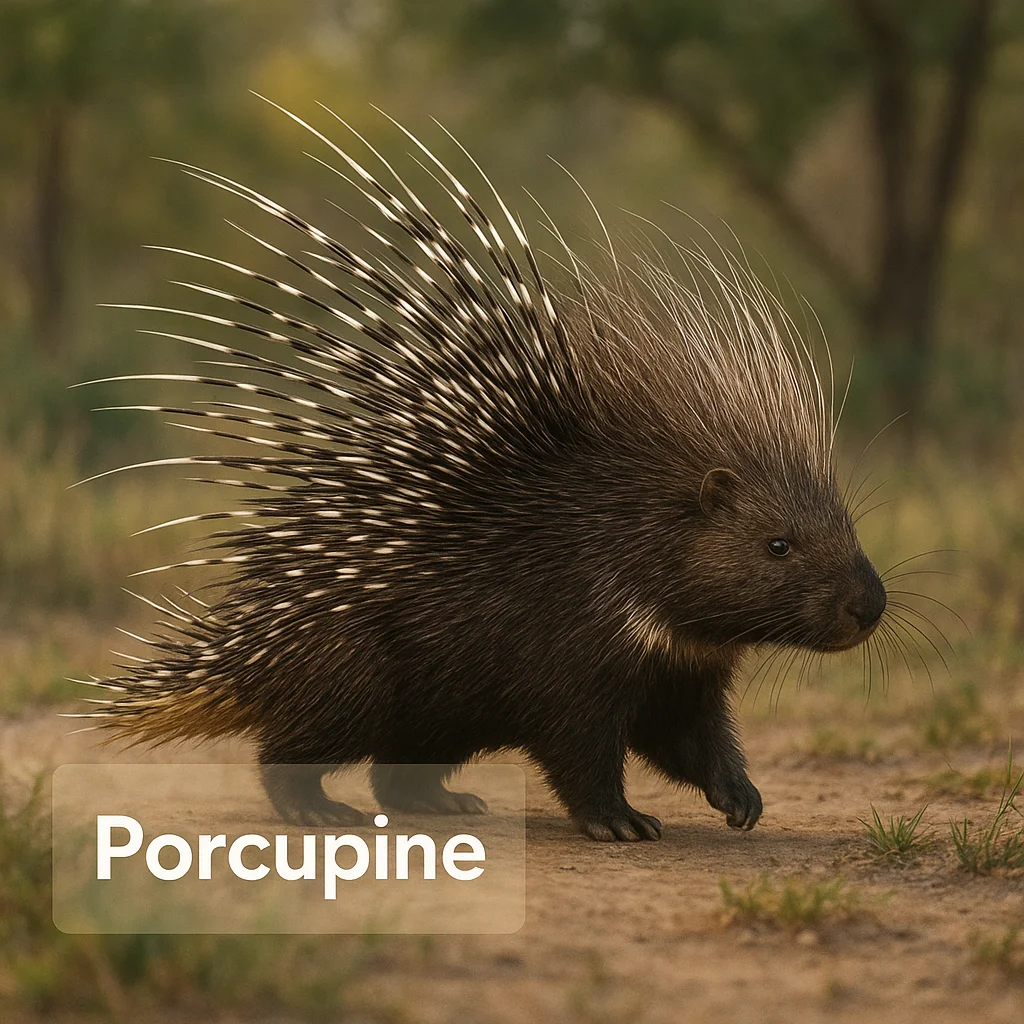
The porcupine is easily recognizable due to its round body covered with long, sharp quills that serve as a defense mechanism. Their quills are usually mixed with coarse hair and come in varying shades of brown, gray, and black. Porcupines have a small face, round ears, and a strong, stubby tail, which in some species is prehensile.
- The silhouette is typically rounded; quills form a spiky outline.
- Quills vary in length but are longest on the back and sides.
- Distinct coloration patterns: often darker on the back compared to the belly.
- Tracks usually show a distinctive dragging mark from the tail.
- Look-alikes include hedgehogs and echidnas, but porcupines are generally larger with longer quills.
- Top ID Tips:
- Round body, covered in sharp quills
- Mixed colors of brown and black
- Small, rounded ears
- Short, stubby legs for climbing
- Longer quills than similar species
- Telltale tail drag in tracks
- Mistaken for hedgehogs but much larger
- Distinctive spiked silhouette
🧱 Body Structure & Physical Adaptations
Porcupines have a stocky build with strong legs that aid in climbing. Their quills are modified hairs coated with thick plates of keratin, which offer protection by detaching easily when predators attempt to attack. Porcupines have a well-developed sense of smell and have large incisors adapted for gnawing.
- Stocky build with strong, climbing legs
- Sharp teeth adapted for gnawing wood
- Sensitive nose for detecting food sources
- Long, easily detachable quills
- Tail usually used for balance while climbing
- Prehensile tail in some species aids climbing
- Quills provide effective defense
- Small eyes but compensated by other senses
🌍 Range & Distribution
Porcupines are widely distributed across various continents, including North America, South America, Africa, and Asia. They inhabit a wide range of environments from arid deserts to lush forests, depending on the species.
- Where You Might Find It:
- North America, particularly in wooded areas
- Sub-Saharan Africa in arid and semi-arid regions
- Asia's tropical and temperate forests
- Across South America's variety of environments
- Typically avoids overly humid tropical rainforests
- Adaptable to various altitudes
- Found in rocky landscapes providing burrows
- Some prefer higher altitudes compared to others
🏞️ Habitat & Shelter
Porcupines prefer habitats that provide ample vegetative cover and food sources, such as forests, grasslands, and deserts. Their habitats often feature rocky crevices or logs where they can find shelter. In colder climates, porcupines might den in hollow trees or caves to escape the harsh weather.
Porcupines do not migrate but may adjust their range slightly in response to food availability and seasonality.
🧭 Behavior & Ecology
Porcupines are primarily solitary creatures, coming together only for mating purposes. They spend their days resting in burrows or trees and venture out at night to search for food. They mark their territories with scent markings and are known for their sharp defense mechanisms when threatened.
- Behavior Highlights:
- Nocturnal foraging and feeding routines
- Territorial animals with scent-marked home ranges
- Typical escape response includes climbing trees
- Do not form large social groups
- Quills used as a deterrent against predators
- Known to exhibit grooming behaviors
- Effective rodent control in their ecosystems
- Involvement in seed dispersal through feces
👥 Social Life & Group Dynamics
Porcupines are predominantly solitary animals that may form temporary bonds for the purpose of mating. They do not have a complex social structure and typically avoid conflicts by utilizing their quills defensively.
- Social Structure Notes:
- Solitary except during mating seasons
- Minimal parental investment beyond nursing
- Rarely engage in social grooming
- Territorial with little tolerance for others
- Temporary mother-offspring pairs post-birth
- Use quills to enforce personal space
- Show limited cooperation
- Home ranges overlap but little interaction
🍽️ Diet, Prey & Predators
Porcupines are herbivores that feed primarily on leaves, twigs, and bark. During different seasons, they might feed on fresh greens or fruit when available. Porcupines' primary predators include large cats, birds of prey, and occasionally humans.
If threatened, porcupines defend themselves using their quills, which they can raise and vibrate as a warning to predators.
- Feeding Notes:
- Preference for bark and woody plants
- Feeding habits change seasonally
- Opportunistic eater if needed
- Use sharp incisors for gnawing
- Under threat from natural predators
- Humans impact them through habitat destruction
- Possess formidable natural defenses
- Store fat reserves for harsh periods
🦌 Hunting, Foraging & Movement
Porcupines are adept climbers when foraging for food, although not fast movers. Their movement is primarily characterized by a slow and deliberate pace. Porcupines often foray across a familiar home range searching for new growth in trees and shrubs.
- Movement & Strategy:
- Slow but deliberate walking style
- Reputed for climbing trees with ease
- Highly adapted for foraging in dense areas
- Little migration; stick to known territories
- Careful navigation to avoid predators
- Using quills as defense rather than speed
- Persistent foraging when necessary
- Home ranges are carefully explored
🧠 Intelligence & Senses
Porcupines possess a well-rounded set of senses, relying heavily on smell for detecting food and potential threats. Their large incisors allow them to access tough food sources. They show limited evidence of complex problem-solving but are efficient in their ecological niche.
- Notable Abilities:
- Strong reliance on scent for navigation and food
- Adaptability to different food sources
- Adequate memory for territory layout
- Excellent climbers
- Quills as a primary defense mechanism
- Limited innate problem-solving
- Nature as a cautious forest dweller
🪺 Reproduction, Pregnancy & Parenting
Porcupines typically have a breeding season that coincides with warmer months. They might engage in basic courtship, such as vocalizations and urine marking, before mating. The gestation period varies across species, usually lasting around 3 months. Females typically birth one or two offspring that are relatively well-developed.
Young porcupines are born with soft quills that harden after a few days, making them less vulnerable to predators.
- Reproduction Snapshot:
- Breeding mainly in summer seasons
- Simple monogamous pairings
- Gestation lasts around 90 to 112 days
- Usually give birth to one or two pups
- Pups are initially reliant on the mother
- Young born with soft quills
- Juveniles are mostly independent
- Limited male involvement in care
♀️♂️ Male vs Female Differences
Generally, porcupines show little sexual dimorphism, though females may be slightly larger. Reproductive roles differ significantly, with females taking on the primary role of care for the young, while males are involved primarily during the breeding season.
- Sex Differences at a Glance:
- Females slightly larger overall
- Quill patterns similar across sexes
- Males have testicles visible during the breeding season
- Females adopted nurturing role
- Males play roles mainly in reproduction
- No significant difference in coloration
- Males engage in competition during mating
- Behavioral differences mostly revolve around reproduction
🧬 Subspecies & Variation
There are multiple species of porcupines, such as the North American porcupine (Erethizon dorsatum) and the African crested porcupine (Hystrix africaeaustralis), each adapted to different environments. They may vary in size, quill length, and behavior based on their geographical region and habitat.
- Variation Notes:
- Several species spread globally
- Weighs more on the African species
- Quill length varies by habitat
- Divided into different genera and families
- Region-specific adaptations in diet
- Some debate in subspecies classification
- Behavior and size adjustments by region
⚠️ Threats, Conservation & Human Interaction
Porcupines face threats from natural predators, habitat loss due to human encroachment, and hunting in some regions. Conservation efforts vary and often focus on habitat preservation and reducing human-wildlife conflict. Effective coexistence includes promoting awareness and preventing contact that might lead to harm on either side.
- Responsible Notes:
- Pace of habitat loss varies by location
- Challenges in human-influenced environments
- Protective regulations not uniform globally
- Awareness education about porcupine ecology
- Ecosystem role understanding can aid efforts
- Consider ethical concerns in interactions
- Promote coexistence and habitat respect
✨ Fun Facts & Unique Traits
- Porcupines have around 30,000 quills, each with barbs that make them stay lodged in predators trying to attack them.
- In their natural habitats, porcupines play a crucial role as rodent scavengers, helping with pest control.
- They can swim well, using their quills for buoyancy in the water.
- Porcupines do not throw their quills; they detach on contact and serve as a painful deterrent.
- The smell of skunk occasionally repels porcupines, as they share some common territory.
- Young porcupines' quills are not initially sharp when they are born soft and gradually harden as they mature.
- Porcupines maintain significant biodiversity by controlling certain plant populations.
- A porcupine’s quills are made with keratin, the same protein in human hair and nails.
📌 Summary
- Appearance characterized by sharp quills and a rounded body
- Found mainly in forests, deserts, and grasslands worldwide
- Herbivorous diet dominated by bark and leaves
- Threatened by large predators and human interference
- Solitary animals except during breeding periods
- Breed primarily in warmer seasons; females provide care to young
- Defensive adaptations include quill usage
- Conservation efforts focus on habitat preservation
- Make valuable nutrient recyclers and plant regulators in ecosystems