🦁 Arctic Tern
🧾 Quick Facts
The Arctic Tern (Sterna paradisaea) is a fascinating migratory bird known for its incredible long-distance flights. Its journey between the Arctic and Antarctic each year is one of the longest migrations in the animal kingdom, allowing it to experience two summers annually and more daylight than any other creature.
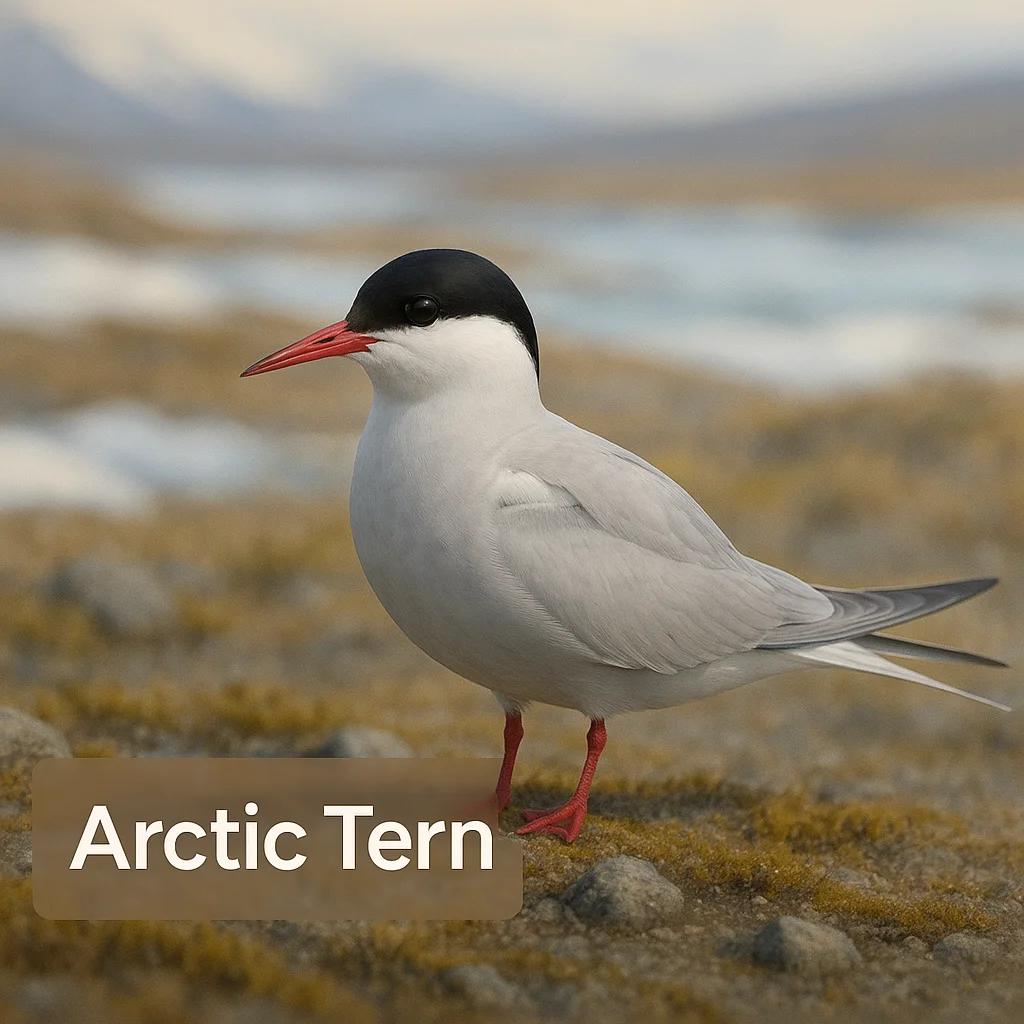
- Common Names: Arctic Tern
- Scientific Name: Sterna paradisaea
- Animal Type: Bird
- Typical Adult Size: 28 to 39 cm in length; wingspan of 76 to 85 cm
- Typical Lifespan: 15 to 30 years in the wild
- Diet Type: Carnivore; primarily fish and small marine invertebrates
- Activity Pattern: Diurnal
- Social Structure: Colonies
- Speed / Movement: Flies up to 35 km/h; migration spans over 80,000 km annually
- Intelligence/Learning: Shows navigational intelligence and learning ability in migration routes
- Primary Habitats: Marine and coastal regions
- Geographic Range: Circumpolar areas; migrates between Arctic breeding grounds and Antarctic wintering grounds
- Predators/Threats: Gulls, foxes, climate change impacts
- Conservation Status: Least Concern, but varies locally
🔍 Identification & Appearance
The Arctic Tern is a medium-sized bird with a sleek, aerodynamic body designed for long flights. Its plumage is largely white, with distinguishing black caps on its head and a sharp, red beak. During breeding season, their underparts take on a slightly grayish hue.
- Streamlined, slender body with a deeply forked tail
- Black cap extending from beak to neck
- Bright red beak and legs, turning blackish outside breeding season
- Pale gray upper wings and back
- Appears entirely white from a distance when flying
- Juveniles have darker wing edges and a paler beak
- Can be mistaken for Common Terns, distinguished by longer migration and more extensive tail streamers
- Top ID Tips
- Look for their characteristic long migratory paths
- Check for the bright red beak during the breeding season
- Note the deeply forked tail in flight
- Listen for sharp cries resembling "keee-ahr"
- Observe behavior in large nesting colonies during breeding
- Pale underparts with faint gray tinge in summer
🧱 Body Structure & Physical Adaptations
The Arctic Tern is adapted to its migratory lifestyle with a number of physical features that enhance its endurance and aerial efficiency. Its body is designed to maximize flight efficiency and endurance.
- Slender, lightweight body optimized for long flights
- Long, narrow wings ideal for dynamic soaring and gliding
- Streamlined beak perfect for catching small fish
- High aspect ratio wings for efficient flying over long distances
- Sensitive vision tuned to spot prey underwater
- Tight plumage providing insulation against cold temperatures
- Black cap provides sun protection for eyes during long migrations
- Key Adaptations
- High flying efficiency due to streamlined body
- Strong muscle development for extended flights
- Robust navigation skills for seasonal migrations
- Endurance for long migratory journeys spanning continents
- Camouflaged coloration for protection during nesting
🌍 Range & Distribution
The Arctic Tern has an extensive geographic range, breeding in the Arctic and sub-Arctic regions, and wintering in the Antarctic, making it one of the most widely traveled species in the world.
- Breeds in the circumpolar Arctic and sub-Arctic regions
- Winters in the Southern Ocean around Antarctica
- Migrates along coastlines and over open seas
- Occasionally seen during migration in the UK, Europe, and parts of North America
- Adapts to various climates from polar to temperate regions
- Where You Might Find It
- Polar ice edges
- Coastal tundra in summer breeding seasons
- Antarctic waters during the non-breeding season
- North American and European coasts during migration
- May inhabit inland lakes during migration stops
🏞️ Habitat & Shelter
The Arctic Tern selects habitats that provide both breeding grounds and ample foraging opportunities. Its nesting success and migration patterns are heavily influenced by environmental conditions.
- Prefers rocky and sandy beaches for nesting
- Breeds on offshore islands and coastal areas
- Often inhabits vegetated areas with low shrubs
- Relies on open marine waters for feeding
- Adapts to seasonal changes by migrating to different hemispheres
Nesting habitats are critical as terns prefer areas with minimal human disturbance and abundant food resources. Seasonal changes, primarily temperature and food availability, dictate their migratory patterns and behaviors.
🧭 Behavior & Ecology
The Arctic Tern is an exceptional aviator, displaying a daily routine centered around its extensive migrations, feeding, and social interactions within colonies during breeding seasons.
- Flies more than 80,000 km annually between breeding and wintering grounds
- Forms large, noisy colonies during breeding seasons
- Vigilant and protective of nesting sites
- Communicates through high-pitched calls and body displays
- Engages in cooperative mobbing to deter predators
- Functions as both predator and prey in marine ecosystems
- Behavior Highlights
- Magnificent long-distance migratory flights
- Partners showcase synchronized aerobatics during courtship
- Vocal cries alert fellow terns to predators
- Regulates nest temperature by constant attendance
- Adjusts feeding strategies seasonally
- Packs in flocks for communal roosting at night
👥 Social Life & Group Dynamics
Being a highly social species, the Arctic Tern demonstrates strong group dynamics particularly evident in breeding colonies where cooperation and pair bonding are key to reproductive success.
- Typically found in colonies, which may number thousands of individuals
- Monogamous pairs often mate for life
- Engages in cooperative defense of nesting sites within colonies
- Little evidence of strict dominance hierarchies; instead, rely on mutual defense strategies
- Chick care is a shared responsibility, with both parents involved
- Social Structure Notes
- Pairs form strong, often lifelong bonds
- Nest-building and incubation duties shared between partners
- Strong colonial breeding with synchronized egg-laying patterns
- Defense against intruders is highly cooperative
- Shows strong site-fidelity, returning to same colony and nest sites
🍽️ Diet, Prey & Predators
The Arctic Tern's diet primarily consists of small fish and marine invertebrates, caught during their graceful diving maneuvers. Its food preferences vary slightly with location and season.
- Fish such as herring and sand eels form a large part of their diet
- Also consumes crustaceans, small squid, and plankton
- Feeding often takes place in flocks, encouraging cooperative foraging
- Main predators include skuas and large gulls during nesting
- Exhibits aggressive behavior toward intruders threatening nests
- Feeding Notes
- Exhibits skillful aerial diving to capture underwater prey
- Adjusts feeding techniques based on prey availability
- Forages in synchrony with tidal movements
- Utilizes sharp eyesight for targeting prey just below water surface
- Relies on open sea and coastal availability of prey
🦌 Hunting, Foraging & Movement
Known for its highly efficient flying capability, the Arctic Tern is a superb long-distance traveler, using its flight adaptations to tirelessly chase prey and navigate between hemispheres.
- Specializes as a flier, using aerodynamic wings for effortless soaring
- Capable of flying tall altitudes and traversing vast oceans
- Shows remarkable stamina with migration crossing entire hemispheres
- Migrates annually from Arctic breeding grounds to Antarctic feeding areas
- Adapts foraging strategies to regions it crosses during migrations
- Movement & Strategy
- Mainly follows coastal and oceanic routes during migrations
- Capable of using magnetic fields for navigation
- High efficiency glider, using thermal currents to travel long-distances
- Agile in maneuvering to avoid predators during flights
- Displays active foraging during daylight when prey is most visible
🧠 Intelligence & Senses
The Arctic Tern exhibits specialized adaptations in its senses and intelligence, particularly in terms of navigation and environmental awareness, crucial for its migration.
- Shows advanced problem-solving in finding optimal migration routes
- Memory allows individuals to return to same nesting sites annually
- Demonstrates use of visual landmarks and sun positioning for navigation
- Acute vision adapted to spotting prey from great heights
- Sensory adaptations allow keen detection of subtle environmental changes
- Notable Abilities
- Remarkable long-distance flyer
- Navigates vast distances annually across hemispheres
- Strong homing instinct; returns to birthplace for breeding
- Adept at synchronizing nest building with partner
- Distinguishes own chicks even in large colonies
🪺 Reproduction, Pregnancy & Parenting
Reproduction in Arctic Terns is tightly linked to their migratory and colonial nature, with courtship and nesting behaviors driven by their annual breeding periods in the Arctic.
- Breeding season occurs during the Arctic summer, typically May to July
- Monogamous pairing is common, with biparental care of offspring
- Typically lay 1-3 eggs in shallow ground nests
- Incubation period ranges from 21 to 25 days
- Chicks are semi-precocial, gain mobility shortly after hatching
- Reproduction Snapshot
- Pairs engage in aerial courtship displays
- Monogamous pair bonds often last several seasons
- Nest recognition and territory defense are vital
- Both parents contribute to chick feeding
- Chicks fledge after about 24 to 30 days
♀️♂️ Male vs Female Differences
In Arctic Terns, sexual dimorphism is subtle, making it challenging to distinguish males from females without observing behavior closely.
- Male and female plumage are similar, with subtle variations in hue
- Males may exhibit slightly longer streamers during breeding seasons
- Gender-specific roles in nesting; both share incubation duties
- Males more active in initial territory defense
- Females often prioritize chick nurturing and feeding post-hatch
- Sex Differences at a Glance
- Similar overall appearance; males slightly brighter
- Roles in courtship ritual typically initiated by females
- Shared incubation with alternating shifts
- Both sexes involved in swooping displays to deter predators<
- Equal contribution to feeding and protection of young
🧬 Subspecies & Variation
The Arctic Tern is relatively uniform across its range, with little officially recognized subspecies differentiation. However, slight morphological and behavioral changes can be regionally observed.
- No widely recognized subspecies, but potential local adaptations
- Variation in size and plumage brightness across different breeding areas
- Paler plumage observed in more southern populations
- Some debate over subspecies classification, lacking genetic clarity
- Variation Notes
- Regional plumage brightness varies with latitude
- Size differences reflect food abundance and climate
- Migration start is timed per region, based on environmental cues
- Slight variations in beak length observed regionally
⚠️ Threats, Conservation & Human Interaction
The Arctic Tern faces natural threats and human-related pressures, especially from climate change and habitat encroachment. Conservation efforts focus on protecting critical breeding and migration sites.
- Natural predators include skuas and predatory birds
- Human activities affecting nesting sites: tourism and development
- Climate change impacts ice melt and available feeding grounds
- Vulnerable to oil spills and marine pollution
- Efforts ongoing to protect important migratory routes and colonies
- Responsible Notes
- Reduce human mall impact in breeding areas
- Promote protected marine areas to offset threats
- Encourage safe viewing distances in wildlife watching
- Climate action critical for preserving migratory pathways
- International cooperation essential for cross-hemisphere conservation
✨ Fun Facts & Unique Traits
- Arctic Terns experience more daylight annually than any other animal
- Their migration is one of the longest known in the animal kingdom
- Arctic Terns undergo a complete molt during their time in the Antarctic
- They can live as long as 30 years, migrating the equivalent distance to the moon and back three times
- Terns can dive from heights of over 10 meters to catch prey
- Their red beak and feet become duller outside of the breeding season
📌 Summary
- Recognizable by their long-distance migration and red-beaked appearance
- Habitat includes polar regions and marine environments
- Circumpolar breeding with Antarctic wintering
- Primarily feeds on fish and aquatic invertebrates
- Faces threats from predators and human-related changes
- Forms highly social breeding colonies with cooperative defense
- Monogamous breeding with strong parental care
- Adaptations for flight efficiency and migration
- Notable for extensive migration and daylength exposure