🦁 Atlantic Puffin
🧾 Quick Facts
The Atlantic Puffin, often regarded as the 'clown of the sea,' is a charismatic seabird known for its striking appearance and exceptional swimming ability. These birds are a staple of North Atlantic marine life and are beloved by bird watchers and nature enthusiasts alike.
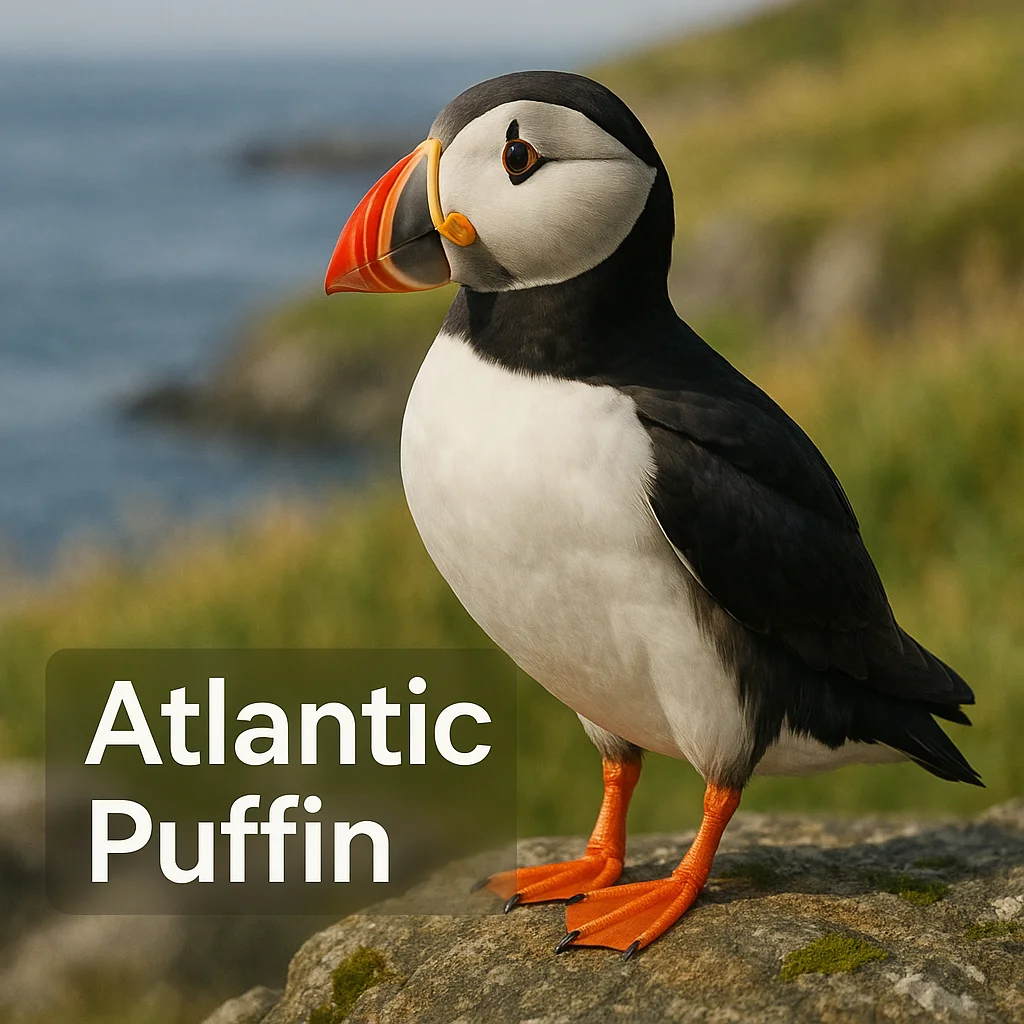
- Common name: Atlantic Puffin
- Scientific name: Fratercula arctica
- Animal type: Bird
- Typical adult size: Approximately 25-30 cm (10-12 inches) in length, with a wingspan of 50-60 cm (20-24 inches)
- Typical lifespan: 20-30 years in the wild
- Diet type: Carnivore; primarily fish such as sand eels, herring, and capelin
- Activity pattern: Diurnal
- Social structure: Colonial; they nest in large groups
- Speed / movement highlights: Excellent swimmers, using wings to 'fly' underwater
- Intelligence/learning: Known for returning to the same nesting sites annually
- Primary habitats: Coastal cliffs and rocky islands
- Geographic range: North Atlantic Ocean, including coasts of Europe, North America, and Iceland
- Predators/threats: Gulls, skuas, and larger fish; human interference and oil spills
- Conservation status: Vulnerable, with local variations in threat level
🔍 Identification & Appearance
Atlantic Puffins are easily recognizable by their vivid beaks and contrasting coloration. Their unique silhouette, featuring a short neck and large head, sets them apart from other seabirds.
- Body shape and silhouette: Compact, stocky body with a rounded head and large beak
- Key colors/patterns: Black back and wings, white underparts; bright orange beak and legs during breeding season
- Distinctive features: Overlarge, triangular beak with an array of colors; bright orange legs
- Tracks, scat, or other field signs: Difficult to spot due to nesting on cliffs, away from land
- Common look-alikes: Can be confused with other puffin species, but differentiate by size and coloration
- Top ID Tips
- Look for large, colorful beaks especially during breeding season
- Notice the bright orange legs during spring and summer
- Observe their powerful swimming style when hunting
- Check for nesting on steep cliffs or rocky islands
- Identify by the rapid, whirring wing beat in flight
- Distinctive trapezoidal shape in silhouette
🧱 Body Structure & Physical Adaptations
The Atlantic Puffin's body is uniquely adapted for life both in the air and underwater. Its anatomical features enable it to be a proficient hunter of fish in the North Atlantic waters.
- Build and proportions: Stocky build with short wings, adapted for burrowing and swimming
- Teeth/beak/jaw adaptations: Large, triangular, and colorful beak that changes color outside the breeding season
- Claws/hooves/wings/fins: Wings are short, optimized for swimming; feet are strong for digging burrows
- Sensory strengths: Keen eyesight for spotting fish underwater; less developed sense of smell
- Key Adaptations
- Wings designed for underwater propulsion
- Strong beak for carrying multiple fish at once
- Compact body reduces water resistance when diving
- Waterproof feathers protect against harsh sea weather
- Nesting in burrows minimizes exposure to predators
🌍 Range & Distribution
The distribution of Atlantic Puffins covers the vast expanses of the North Atlantic Ocean. Their presence is a hallmark of healthy coastal and marine ecosystems across various countries.
- Continent/regions: North Atlantic, ranging from Europe to North America
- Typical countries/biomes: Found in Iceland, Norway, Faroe Islands, Newfoundland, and the British Isles
- Elevation/climate range: Occurs typically at sea level on coastal islands
- Seasonal movements or migration: Migratory, with significant dispersal in the winter months
- Where You Might Find It
- Coastal regions of Iceland
- Western and northern coasts of Norway
- Cliffs of the Faroe Islands
- Rocky islands around Newfoundland
- Scottish isles and western Ireland
🏞️ Habitat & Shelter
The Atlantic Puffin's habitat consists mainly of rugged coastal regions, preferring environments that support their unique nesting and feeding behaviors. Understanding their preference for such habitats gives insight into their ecological needs and behaviors.
- Preferred habitats: Coastal cliffs and rocky isles for nesting; open ocean waters for feeding
- Microhabitats and shelter: Burrows in soft earth on cliffsides; narrow crevices on rock faces
- How weather/season changes behavior: Migratory patterns shift in harsh weather; burrowing shelters from storms
- Why habitat knowledge matters: Critical for protecting breeding sites and understanding distribution changes
🧭 Behavior & Ecology
Atlantic Puffins exhibit a variety of behaviors essential both for individual survival and the maintenance of their social colonies. These behaviors highlight the species' adaptability within their ecological niche.
- Daily routine, resting, grooming, territoriality: Daylight foraging and nighttime burrow retreats
- Communication: Vocal clucking calls; visual displays during courtship
- Typical interactions with other species: Occasional competition with gulls for nesting sites
- Role in the ecosystem: Important predators of small fish; contribute to nutrient cycles in coastal habitats
- Behavior Highlights
- Form monogamous breeding pairs
- Use distinct calls to communicate within colonies
- Return to traditional nesting sites annually
- Form large, noisy colonies for breeding
- Competition and displacement of interspecies competitors, especially among seabirds
👥 Social Life & Group Dynamics
Atlantic Puffins are highly social during the breeding season, forming large, bustling colonies. Their social structures are vital for ensuring successful reproduction and the continuation of their species.
- Solitary vs social tendencies: Highly social during breeding; solitary or small groups in off-seasons
- Group types and typical size range: Colonies can number in the thousands
- Cooperation: Parents share incubation and chick rearing duties
- Dominance hierarchies and conflict resolution: Minimal conflict within established pairs; colony cohesion is paramount
- Social Structure Notes
- Establish pair bonds for life
- Participate in colony-based nesting and care
- Show synchronized departure for foraging
- Utilize collective predator detection
- Feed chicks in rotational shifts by pairs
🍽️ Diet, Prey & Predators
The diet of the Atlantic Puffin primarily consists of fish, supplemented by crustaceans and marine invertebrates. Their feeding strategy is linked to their proficient swimming skills and effective hunting coordination within colonies.
- What it eats: Primarily small fish like sand eels, herring, and capelin; occasionally crustaceans
- Hunting targets and strategies: Pursuit diving, utilizing wings to navigate underwater quickly
- Main natural predators: Predatory birds like gulls and skuas; large predatory fish
- Anti-predator defenses: Use cliff-side nesting for reduced access by terrestrial predators
- Feeding Notes
- Primarily piscivorous diet with seasonal variability
- Known for carrying multiple fish crosswise in their beaks
- Nests away from easily accessible predators
- Foraging often influenced by tidal conditions
- Utilize clear-water conditions for better visibility during hunts
🦌 Hunting, Foraging & Movement
Atlantic Puffins are remarkable for their specialized hunting and movement adaptations. Their adept swimming and foraging skills play vital roles in their life cycle and enable them to thrive in the harsh marine environment.
- Locomotion style: Flier and swimmer; uses fast wing beats for both flying above and beneath water
- Speed and endurance: Surprisingly quick swimmers able to 'fly' through water to chase fish
- Typical hunting/foraging times and tactics: Diurnal foragers, diving in daylight hours
- Navigation and spatial behavior: Strong homing instincts for returning to nesting sites
- Movement & Strategy
- Excel at underwater propulsion using wing strokes
- Move between nesting sites seasonally
- Adapted to ocean currents for long-range migration
- Synchronize flights with other colony members
- Breeding dictates extensive movement patterns
🧠 Intelligence & Senses
The intelligence of Atlantic Puffins is reflected in their complex behaviors and adaptability. Their sensory abilities and problem-solving skills play crucial roles in their survival, particularly within bustling colonies and predator-rich environments.
- Problem-solving, learning: Advanced knowing returning behavior to existing colonies
- Senses: Keen sight for catching prey; less reliant on smell
- State uncertainties: Senses well-understood; cognitive aspects vary in understanding
- Notable Abilities
- Exemplar homing abilities to former nesting sites
- Utilizes visual cues during underwater hunting
- Colony communication displayed through sound
- Skilled at selecting nesting sites to minimize threats
- Perceptive in detecting changing weather conditions
🪺 Reproduction, Pregnancy & Parenting
Reproductive cycles in Atlantic Puffins are tightly linked to specific environmental cues and nesting site conditions. Their enduring pair bonds and shared parenting duties ensure high juvenile survival rates against numerous challenges.
- Breeding seasonality and courtship: Occurs in spring; elaborate displays to attract mates
- Mating system: Serially monogamous, forming long-term pair bonds
- Incubation period: Typically around 36-45 days
- Litter/clutch size: Usually a single chick per breeding season
- Parenting roles: Shared equally, with both parents involved in feeding and protection
- Reproduction Snapshot
- Elaborate courtship precedes pairing
- Pair bonding persists across multiple seasons
- Both parents alternate incubation duties
- Chick rearing is a mutual endeavor
- Single chick fosters focused parental care
♀️♂️ Male vs Female Differences
While Atlantic Puffins exhibit some sexual dimorphism in terms of size, much of their behavior and appearances are quite similar. These subtle differences can be challenging to observe without detailed examination.
- Size/weight differences: Males are typically slightly larger than females
- Coloration: Both sexes display similar plumage coloration
- Behavioral role differences: Both roles contribute equally to parenting and territory defense
- Subtle differences: Observationally minimal in field identification
- Sex Differences at a Glance
- Males generally larger
- Similar coloration between sexes
- Shared roles in chick rearing
- Equal involvement in territory marking
- Coordination in nest security
🧬 Subspecies & Variation
Though the Atlantic Puffin is generally considered a singular species, minor regional morphological variation exists across their extensive range.
- Known subspecies: Currently recognized as a single species with no broadly accepted subspecies
- Local adaptations: Differences in body size and plumage patterns due to local environmental pressures
- Subspecies classification: Not debated, considered monotypic as Fratercula arctica
- Variation Notes
- Subspecies distinction not widely applied
- Size varies with dietary availability
- Limited color pattern variation regionally
- Adaptive behavior based on specific location
- Uniform structure save for minor local distinctions
⚠️ Threats, Conservation & Human Interaction
Atlantic Puffins face numerous natural and anthropogenic threats, impacting their conservation status across various geographical regions. Ongoing conservation efforts focus on habitat protection and minimizing human-induced pressures such as pollution and overfishing.
- Natural challenges and human-related pressures: Predation, oil spills, and overfishing
- Conservation measures: Focused on habitat protection and minimizing bycatch
- Coexistence tips: Maintaining preserved nesting sites and reducing pollution impacts
- Species commonly kept: Observed in controlled settings such as wildlife sanctuaries for conservation purposes
- Responsible Notes
- Avoid disrupt habitats during nesting season
- Support marine conservation initiatives
- Adhere to wildlife observation guidelines
- Engage with citizen science projects responsibly
- Promote awareness of marine health
✨ Fun Facts & Unique Traits
- Their beak colors fade after the breeding season, reverting to a more muted hue.
- Atlantic Puffins can hold multiple fish in their beak at one time, using their tongue to trap them against spines.
- Known as 'sea parrots' due to their vibrant beak color and similar profile.
- Capable of diving up to 60 meters below the sea surface in pursuit of prey.
- Puffins can beat their wings up to 400 times per minute to maintain flight.
- The scientific name, Fratercula arctica, means "little brother of the north."
- They are often seen 'rafting' on the sea's surface between dives.
- Each puffin chick is known as a 'puffling.'
- They have a distinctive 'growling' call to communicate within colonies.
📌 Summary
- The Atlantic Puffin can be identified by its colorful beak and striking orange legs.
- Inhabits coastal cliffs and islands, often breeding in crevices and burrows.
- Geographical range includes the North Atlantic, with key populations in Iceland and the British Isles.
- Diet consists mainly of small fish, including sand eels and capelin.
- Natural predators include gulls and larger fish, with threat levels influenced by human activities.
- Highly social during the breeding season, forming large colonies.
- Breeding pairs are monogamous, with shared incubation and care duties.
- Key adaptations include excellent swimming skills and the ability to carry multiple fish in their beaks.
- Recognized for their engaging behaviors and significant ecological role.