🦁 Brown Pelican
🧾 Quick Facts
The Brown Pelican is an iconic seabird species known for its large size, distinctive bill, and graceful flight. Found primarily along coasts, it plays a crucial role in marine ecosystems as a top predator and an indicator species for ocean health.
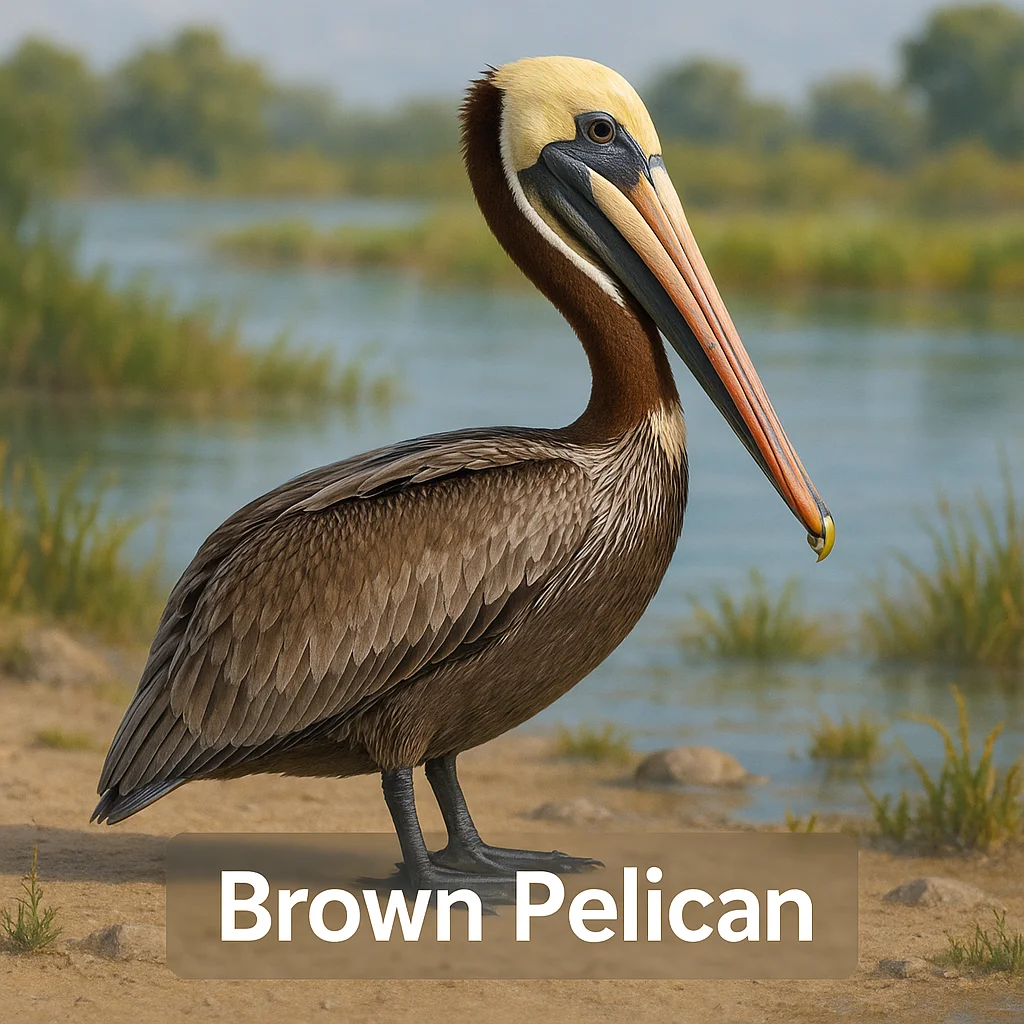
- Common name: Brown Pelican
- Scientific name: Pelecanus occidentalis
- Animal type: Bird
- Typical adult size: 106 to 137 cm (body length), wingspan of 200 to 230 cm
- Typical lifespan: 10 to 25 years in the wild
- Diet type: Carnivore; primarily fish
- Activity pattern: Diurnal
- Social structure: Colonial; often found in groups
- Speed/movement highlights: Capable of short bursts for fishing dives
- Intelligence/learning: Exhibits problem-solving skills, particularly related to feeding and foraging
- Primary habitats: Coastal areas, estuaries, and bay regions
- Geographic range: North America, Central America, South America, Caribbean islands
- Predators/threats: Humans, large birds of prey, environmental pollution, habitat loss
- Conservation status: Least Concern, but varies by region
🔍 Identification & Appearance
The Brown Pelican is easily identified by its massive bill, long neck, and large body, all of which contribute to its unique silhouette, especially in flight. Its plumage features mottled brown and gray colors that tend to change slightly with the season and age.
- Distinctive long and flat bill with a pronounced throat pouch for catching fish
- Dark brown body with varied shading; paler head and neck during non-breeding season
- In breeding plumage, the neck becomes a rich chestnut or dark brown
- Keen eyesight, aiding in spotting fish below the water surface
- Often confused with the American White Pelican but lacks the bright white body coloration
- Massive bill and large throat pouch
- Mottled brown and gray plumage
- Nearly two-meter wingspan
- Distinct gliding flight pattern
- Paler head during non-breeding, richer in color during breeding
- Characteristic diving behavior for hunting
- Preferentially seen along coastal waters
- Unmistakable long neck and large body
🧱 Body Structure & Physical Adaptations
The Brown Pelican exhibits a robust structure with several adaptations that enhance its survival in coastal and marine environments. Its body is streamlined for efficient flight and hunting dives, and it possesses specialized features that facilitate its piscivorous diet.
- Strong and elongated skeletal structure supporting a long bill and neck
- Flexible throat pouch that stretches to scoop up fish and water during dives
- Webbed feet for swimming and steady takeoff from water surfaces
- Specialized air sacs beneath the skin that cushion the impact of dives
- Enhanced eyesight, allowing precise targeting of fish
- Long, flat bill with extensible throat pouch
- Webbing between all four toes for effective swimming
- Air sacs for impact absorption during high-velocity dives
- Exceptional visual acuity for fish detection
- Adapted neck muscles to manage vigorous entry into water
- Sturdy wings and streamlined body for extended flights
🌍 Range & Distribution
Brown Pelicans are widespread throughout the North, Central, and South American coasts. Their range varies slightly depending on the season, although they are predominantly resident in many areas, rarely straying far from coastal habitats.
- Found along the Pacific and Atlantic coasts of the Americas
- Resides in the southeastern United States, including Florida and the Gulf Coast
- Common in Central American waters along the Caribbean and Pacific
- Range extends into northern South America
- Non-migratory but may exhibit localized movements based on food availability
- Gulf of Mexico
- Pacific coastlines from California to Peru
- Atlantic coasts of the United States to northern Brazil
- Brackish water environments
- Coastal bay areas and inlets
- Shores of Caribbean islands
- No inland presence
- Stable coastal and marine distributions
- Primarily saltwater habitats
🏞️ Habitat & Shelter
Brown Pelicans are coastal birds that thrive in warm, marine environments where fish are abundant. Their preferred habitats are typically shallow waters near shores where food is plentiful, but they can also be found resting on rocks, piers, and other coastal structures.
- Coastal and estuarine regions with shallow waters for fishing
- Nesting typically on isolated islands, away from predators
- Roosting sites include piers, docks, and sandy shores
- Avoids inland regions, relying heavily on coastal food sources
- Behavior may change with tides, influencing foraging timing and location
🧭 Behavior & Ecology
The behavior of the Brown Pelican is built around its remarkable hunting method, flight ability, and its social living in colonies. These pelicans are known for their cooperative social structures and efficient foraging techniques, which include precision dives from heights to capture prey.
- Spectacular dive hunting from considerable heights
- Socially roosting and nesting in large colonies
- Vocalizations primarily composed of deep grunts during social interactions
- Play a significant role as predators influencing fish population dynamics
- Clean feathers using bill to distribute oils, keeping feathers buoyant and waterproof
- Dive from 20-30 feet (6-9 meters) into the water
- Communicate through non-vocal sounds and gestures
- Participate in cooperative feeding displays
- Use keen eyesight to spot fish from above
- Integral to marine ecosystems as top-level aquatic predators
- Regular preening for feather maintenance
- Balance predator-prey relationships in coastal waters
- Protection provided to young within colonies
👥 Social Life & Group Dynamics
Brown Pelicans are highly social birds that often breed, roost, and forage in groups called colonies. Their social structure enhances their survival by providing safety in numbers from predators and facilitating learning from other colony members, especially in foraging efficiency.
- Colony life reinforces safety and foraging success
- Typically form small to large colonies depending on geographic location
- Cooperative in foraging, occasionally diving synchronously for fish
- Minimal aggression in colonies but exhibit pecking order during breeding
- Pair bonding is seen but varies seasonally and geographically
- Form colonies on islands and remote coastal areas
- Cooperate in group foraging strategies
- Pairs form during the breeding season
- Vocal and visual displays to assert nesting site resources
- Engage in mutual preening to reinforce social bonds
- Nest sites exhibit a dominance hierarchy
- Population sizes at roosts can greatly vary
🍽️ Diet, Prey & Predators
The diet of the Brown Pelican consists mostly of fish, which they catch by performing spectacular, high-energy dives into the water. While their prey range can change with location and season, they generally focus on schooling fish. Their predators include large birds of prey and, occasionally, mammals that target their eggs and young.
- Diet primarily consists of menhaden, anchovies, and herring
- Capture prey by air-diving from heights and engulfing large volumes of water and fish
- Occasionally seen scavenging along coastlines
- Uses refined flight patterns to follow fish schools
- Adults have few predators; eggs and chicks can fall prey to raccoons, gulls, and hawks
- Specializes in catching surface and mid-water fish species
- Targets schools of small fish
- Synchronize dives with other pelicans
- Maintain feeding efficiency through experience and group communication
- Have a seasonal diet shift based on fish abundance
- Avoids areas with strong currents or poor visibility
- Infrequently hunted by large raptors
🦌 Hunting, Foraging & Movement
Brown Pelicans employ various strategies for hunting and foraging, with air-diving being the most iconic method. Their movement is primarily gliding and soaring, allowing them to conserve energy while scanning for fish near the water's surface.
- Efficient gliders using updrafts along coastal cliffs and waves
- Utilize air-diving for accurate fish captures, often seen diving from high altitudes
- Participate in cooperative feeding with other pelicans and seabirds
- Demonstrate significant endurance, traveling long distances for foraging
- Occasionally rest on water surfaces due to buoyant bodies from air sacs
- Glide long distances with minimal energy use
- Dive accurately from high altitudes for concise prey capture
- Move between local foraging grounds regularly
- Utilize thermal air currents for efficient movement
- Cooperative diving and foraging with colony members
- Capitalizes on schools of fish in known feeding areas
- Stays near coastlines but can travel if food scarcity occurs
🧠 Intelligence & Senses
With exceptional visual acuity and learned behaviors, Brown Pelicans demonstrate cognitive abilities crucial for survival in their environments. They are adept at learning from peers and have adapted to changes in their environments over centuries.
- Keen eyesight assists with precise fishing from aerial heights
- Observational learning is present in juvenile pelicans, learning from adults
- Displays problem-solving skills, especially regarding feeding techniques
- Effective communication through body language and informal hierarchies within colonies
- Adapts behavior based on environmental changes and available resources
- Highly refined eyesight for detecting fish underwater
- Social learning observed among foraging groups
- Sensitive to environmental contaminants
- Proficient at recognizing prime foraging locations
- Show adaptability in foraging techniques depending on seasonal shifts
- Displays some flexibility in breeding strategies based on predation pressure
🪺 Reproduction, Pregnancy & Parenting
Brown Pelicans usually breed in large colonies, often on isolated islands free from land predators. They form monogamous pairs during each breeding season, although pair bonds may not last for multiple years.
- Breeding typically occurs once yearly in colonies
- Nests are built on the ground or in low trees and bushes
- Both sexes participate in incubation and feeding of young
- Incubation lasts around 30 days, with fledging occurring after 9-12 weeks
- Numerous chicks are raised during suitable breeding years
- Seasonal breeding affected by food availability and local climate
- Nests consist of sticks and surrounding vegetation
- 2-3 eggs per clutch is typical, with variable success rates
- Both parents share incubation duties equally
- Chicks are altricial, requiring significant parental investment
- Parental regurgitation for feeding fledglings
- Juveniles remain in colony post-fledging for social learning
♀️♂️ Male vs Female Differences
While male and female Brown Pelicans show only subtle sexual dimorphism, certain behavioral roles, particularly during the breeding season, can exhibit differences. Physically, males might be marginally larger, but visual differences are minimal.
- Males tend to be larger than females, although overlap is common
- No significant differences in plumage coloration
- Males participate more in territorial defense during nesting season
- Female involvement often extends more towards chick nurturing
- Behavioral roles converge during non-breeding periods
- Size variance with males slightly larger
- Non-distinctive plumage between sexes
- Convergence of parental roles for feeding
- Coordinate during nesting site selection and building
- Similar feeding territories during breeding season
- Jointly guard nest sites
🧬 Subspecies & Variation
Regional variations within the Brown Pelican populations can occur; however, they are generally uniform in appearance and behavior across their range. Local adaptations in diet or habitat preference may depend on geographic factors.
- Minor size and plumage variations reported, often due to regional adaptations
- Distribution can be affected by local prey abundance and coastal geography
- Specific populations may exhibit variations in nesting density and site selection
- Pelican subspecies largely feature uniform behavior across regions
- Overall classification as a singular species with little subspecies diversity recognized
- Uniform in basic physical characteristics
- Some isolated populations exhibit slight size variations
- Adaptive behaviors noted in response to coastal environmental changes
- Consistency in basic ecological roles across diverse regions
- Regional dietary shifts based on fish population dynamics
⚠️ Threats, Conservation & Human Interaction
The Brown Pelican faces several challenges ranging from environmental pollution to habitat degradation. Though currently listed as Least Concern, certain populations are affected by local conditions such as fisheries bycatch and climate change.
- Vulnerable to oil spills and environmental contaminants affecting food sources
- Coastal development leads to habitat loss and modified nesting areas
- Impacts from climate change alter fish populations and flooding patterns
- Monitoring and conservation efforts help stabilize populations
- Populations can recover with protective legislation for breeding colonies
- Sensitive to habitat disruptions
- Benefited from pollution regulation policies
- Successful species recovery post-conservation intervention
- Interactions with fisheries affect food availability
- Resilient but need protected areas for sustained nesting
- Conservation provides insight into broader marine ecosystem health
✨ Fun Facts & Unique Traits
- Brown Pelicans perform impressive aerial dives to catch fish
- One of the only pelican species to engage in plunge-diving
- Their throat pouch can hold up to three gallons of water and fish
- Able to soar for hours using wind pressure over waves
- Nurturing parents, with both sexes feeding young post-hatch
- Recovery from near extinction in the 1970s attributed to DDT ban
- Fossil records show pelican lineages extending 30 million years
- Adaptable to new environments with sufficient time and care
📌 Summary
- Identifiable by large bill, throat pouch, and brown plumage
- Inhabits coastal and estuarine environments across the Americas
- Primarily feeds on fish, employing dramatic diving techniques
- Colony-living enhances survival and success
- Recovery success demonstrates resilience to environmental changes
- Unmistakable silhouette when gliding above coastal waters
- Capable of adapting diets to changing prey distributions
- Architects of diverse social structures within colonies
- Indicative species for environmental health assessments
- Long-distance foragers optimizing coastal thermal currents for travel
- Engage in cooperative feeding strategies, reflecting social learning
- Involved in parental duties that underpin their complex life cycle