🦁 Eurasian Spoonbill
🧾 Quick Facts
The Eurasian Spoonbill is a striking, long-legged wading bird known for its distinctive spoon-shaped bill. It is often seen wading through shallow waters across parts of Europe, Asia, and North Africa.
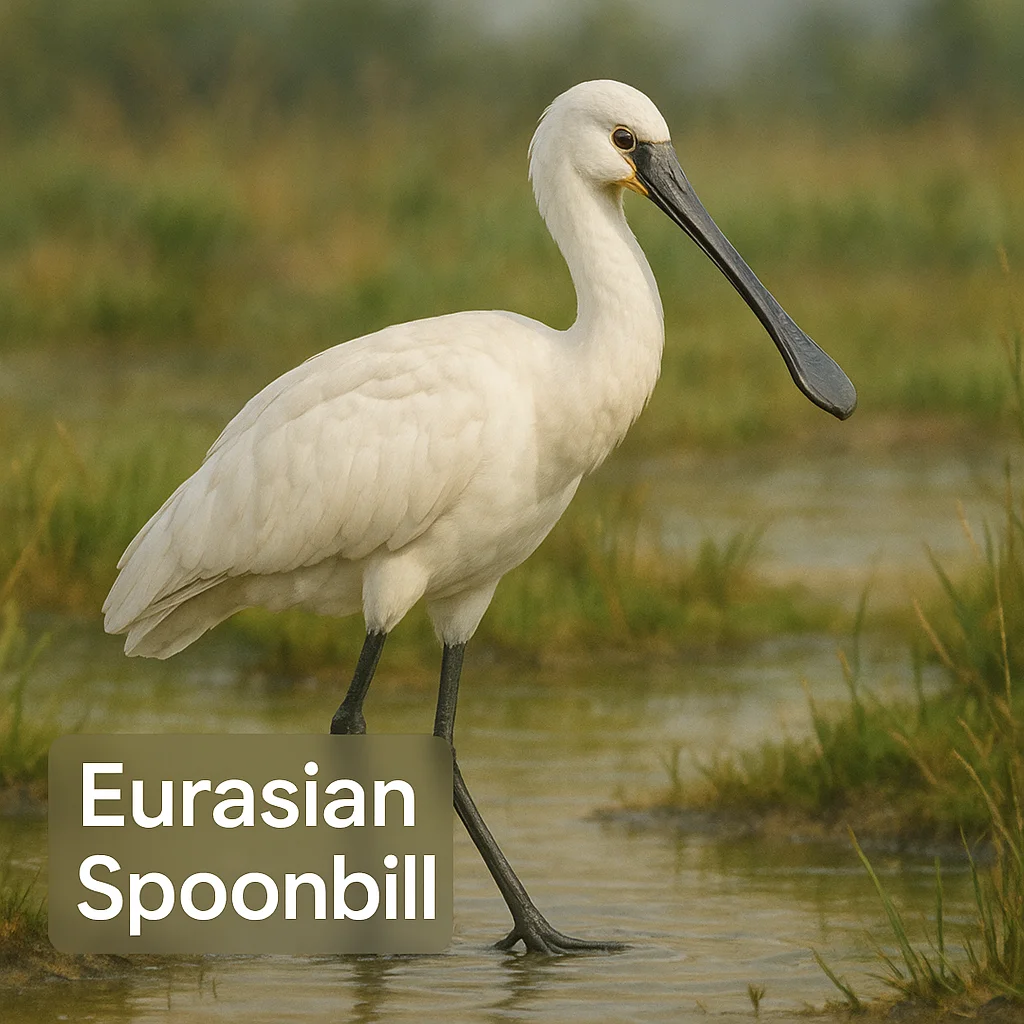
- Common name(s): Eurasian Spoonbill
- Scientific name: Platalea leucorodia
- Animal type: Bird
- Typical adult size: 80–93 cm (31–37 inches) in length, 1–1.9 kg (2.2–4.2 lbs) in weight
- Typical lifespan: 15–20 years in the wild
- Diet type: Carnivore; primarily small aquatic animals like fish and crustaceans
- Activity pattern: Diurnal
- Social structure: Typically forms colonies
- Speed / movement highlights: Moderate flyer; glides with slow, deliberate wing beats
- Intelligence/learning: Known for adaptability and resourceful foraging techniques
- Primary habitats: Wetlands, marshes, shallow lakes
- Geographic range: Europe, Asia, North Africa
- Predators/threats: Large birds of prey, habitat destruction, human disturbance
- Conservation status: Least Concern (varies by region)
🔍 Identification & Appearance
The Eurasian Spoonbill is easily recognizable by its unique, long, flat, spoon-shaped bill, which is ideal for sifting through water for food. It is a large, white, wading bird with a distinctive black-tipped bill and long, dark legs.
- Body shape and silhouette: Slender body with long legs and neck
- Key colors/patterns: Mainly white with slight yellowish hues near the nape during breeding season
- Distinctive features: Spoon-shaped bill, crest on head during breeding season
- Tracks and signs: Large three-toed footprints in mud, distinctive feeding marks in shallow water
- Common look-alikes: Could be confused with herons or egrets; distinguished by its unique bill shape
- Look for the long, spoon-shaped bill
- White plumage with slight coloration during breeding
- Long, dark legs are a key feature
- Observe the slow, deliberate wing beats in flight
- Check for large colonies in wetland areas
- Observe foraging by sweeping its bill side to side in water
🧱 Body Structure & Physical Adaptations
The Eurasian Spoonbill is adapted for life in aquatic environments with several specialized features. Its build allows efficient movement and feeding in water.
- Build and proportions: Slim with long neck and legs, suitable for wading
- Beak adaptations: Spoon-shaped bill for scooping prey from water
- Wing adaptations: Long wings with slow wingbeats for stable flying over long distances
- Sensory strengths: Sharp eyesight for detecting prey beneath the water's surface
- Adapted for aquatic environments
- Spoon-shaped bill aids in catching food
- Long legs allow wading through various water depths
- Sensitive bill tip to detect prey movement
- Slender build for efficient flight
- Sharp vision for spotting prey
🌍 Range & Distribution
The Eurasian Spoonbill has a wide distribution across different continents, favoring wetland areas where it can find ample resources for feeding and nesting.
- Primarily found in Europe, Asia, and parts of North Africa
- Breeding populations in central and southern Europe, extending into Asia
- Prefers lowland regions, particularly near freshwater and estuarine environments
- Seasonal migrations observed in some populations
- May be found in coastal regions during colder months
- Wetlands of southern Europe
- Marshes in central Asia
- Coastal zones in North Africa
- Shallow lakes near migratory paths
- Freshwater estuaries
- Seasonal floodplains
🏞️ Habitat & Shelter
Eurasian Spoonbills are highly dependent on wetland habitats. They require areas with shallow waters that provide not only food but also suitable nesting sites during breeding seasons.
Preferred habitats include marshes, estuaries, and tidal flats. Seasonal variations in water levels can affect their nesting and feeding behaviors.
🧭 Behavior & Ecology
The Eurasian Spoonbill is mostly active during the day, spending a significant amount of time feeding and grooming. They are known for their communal nesting habits and complex foraging strategies.
- Daily routine: Foraging during the day, resting during midday
- Communication: Mostly silent; occasional grunts and hums
- Interactions with species: Coexists with other wading birds; some competition for food
- Ecosystem role: Predators of small aquatic organisms, aiding in controlling their populations
- Forming loose nesting colonies in breeding season
- Foraging by tactile hunting method using bill
- Occasional migration to find food and breeding spaces
👥 Social Life & Group Dynamics
Eurasian Spoonbills are social birds that often nest in colonies. The group structure allows better protection against predators and increased foraging success.
- Social tendencies: Highly social; forms large nesting colonies
- Group types: Colonies during breeding season, typically 10–100 nests
- Cooperation: Shared defense against predators, communal care of nesting areas
- Observe rotational guardianship at nesting sites during feeding
- Colony size can reach hundreds during peak breeding
🍽️ Diet, Prey & Predators
The Eurasian Spoonbill's diet consists mainly of aquatic animals such as fish and crustaceans. They are skilled foragers, using their spoon-shaped bills to sift through the water and mud to capture prey.
- Diet: Primarily fish, crustaceans, small amphibians
- Predators: Birds of prey, occasionally mammals attacking nests
- Anti-predator defenses: Nesting in colonies offers safety in numbers
- Seasonally varied diet based on local prey availability
- Feeds primarily at dawn and dusk
🦌 Hunting, Foraging & Movement
The Eurasian Spoonbill is primarily a wader, using its unique bill to sift through shallow water for food. It is capable of long, low-energy flights, which is advantageous for migratory movements.
- Locomotion style: Primarily a wader; capable of sustained flights
- Feeds via tactile foraging; sweeping bill side to side
- Regularly migrates between breeding and wintering grounds
- Movement includes seasonal migration to warmer regions
- Foraging includes using touch to capture prey
🧠 Intelligence & Senses
Eurasian Spoonbills exhibit clever foraging behaviors and social interactions. Their senses, especially eyesight and touch, are highly developed to support their lifestyle in varied environments.
- Proficient in tactile foraging techniques
- Uses vision to navigate complex wetlands
- Demonstrates learned behaviors in group settings
- Relies on acute senses to avoid predators
- Intelligent foraging strategies developed through adaptation
🪺 Reproduction, Pregnancy & Parenting
Eurasian Spoonbills engage in seasonal breeding with complex courtship rituals. They form monogamous pairs that often return to the same nesting sites each year.
- Breeding season: Generally spring and summer
- Mating system: Monogamous
- Incubation period: About 21–25 days
- Clutch size: Typically 3–5 eggs
- Both parents share incubation duties
- Chicks are semi-precocial, requiring significant parental care
♀️♂️ Male vs Female Differences
In terms of physical appearance and roles, there are subtle differences between male and female Eurasian Spoonbills.
- Size/weight differences: Generally similar, with males slightly larger
- Coloration: Little variation; both sexes have similar plumage
- Behavioral roles: Shared responsibilities in caring for young
- Physical differences are minimal
- Both sexes develop breeding crest
- Male and female often indistinguishable by sight
🧬 Subspecies & Variation
There are slight variations within the Eurasian Spoonbill populations, but distinct subspecies are typically not recognized.
- Subspecies classification is not widely accepted
- Variations occur due to regional habitat conditions
- No notable morphological differences among populations
- Coloration and size remain consistent across range
- Local adaptations are primarily behavioral
⚠️ Threats, Conservation & Human Interaction
The Eurasian Spoonbill faces several threats, mainly habitat destruction and disturbance from human activities. Conservation efforts focus on protecting wetland habitats and creating awareness of their ecological roles.
- Threats from wetland drainage and pollution
- Human disturbance during breeding season can cause colony abandonment
- Conservation measures include habitat protection
- Human interaction mainly involves eco-tourism and educational programs
- Persistent monitoring and management of breeding sites
✨ Fun Facts & Unique Traits
- The spoonbill's distinct bill shape is a result of specialized evolution for foraging.
- Eurasian Spoonbills can be seen performing a unique "dance" while foraging, moving their heads in sweeping motions.
- They are among the few birds that use tactile foraging techniques extensively.
- Spoonbills often engage in synchronized flying during migration, forming sleek shapes in the sky.
- Dued to their striking appearance, they are often featured in nature documentaries.
- The species name "leucorodia" comes from Greek words meaning "white" and "rose," reflecting their plumage.
📌 Summary
- The Eurasian Spoonbill is a unique wader bird distinguished by its spoon-shaped bill and elegant white plumage.
- They thrive in wetland habitats across Europe, Asia, and North Africa.
- Primary diet consists of small aquatic animals found in shallow waters.
- Spoonbills are social, often forming large colonies during the breeding season.
- They engage in seasonal migrations, adapting to changes in food availability.
- Breeding includes shared parental duties, with both sexes involved in incubation and care.
- Despite subtle differences in male and female roles, both share similar physical traits.
- Conservation efforts are crucial to combat habitat loss and ensure species survival.