🦁 Great Cormorant
🧾 Quick Facts
The Great Cormorant, often referred to by its scientific name Phalacrocorax carbo, is a large aquatic bird found across a wide geographic range. Recognized for their diving ability, Great Cormorants play a vital role in aquatic ecosystems as both predators and prey.
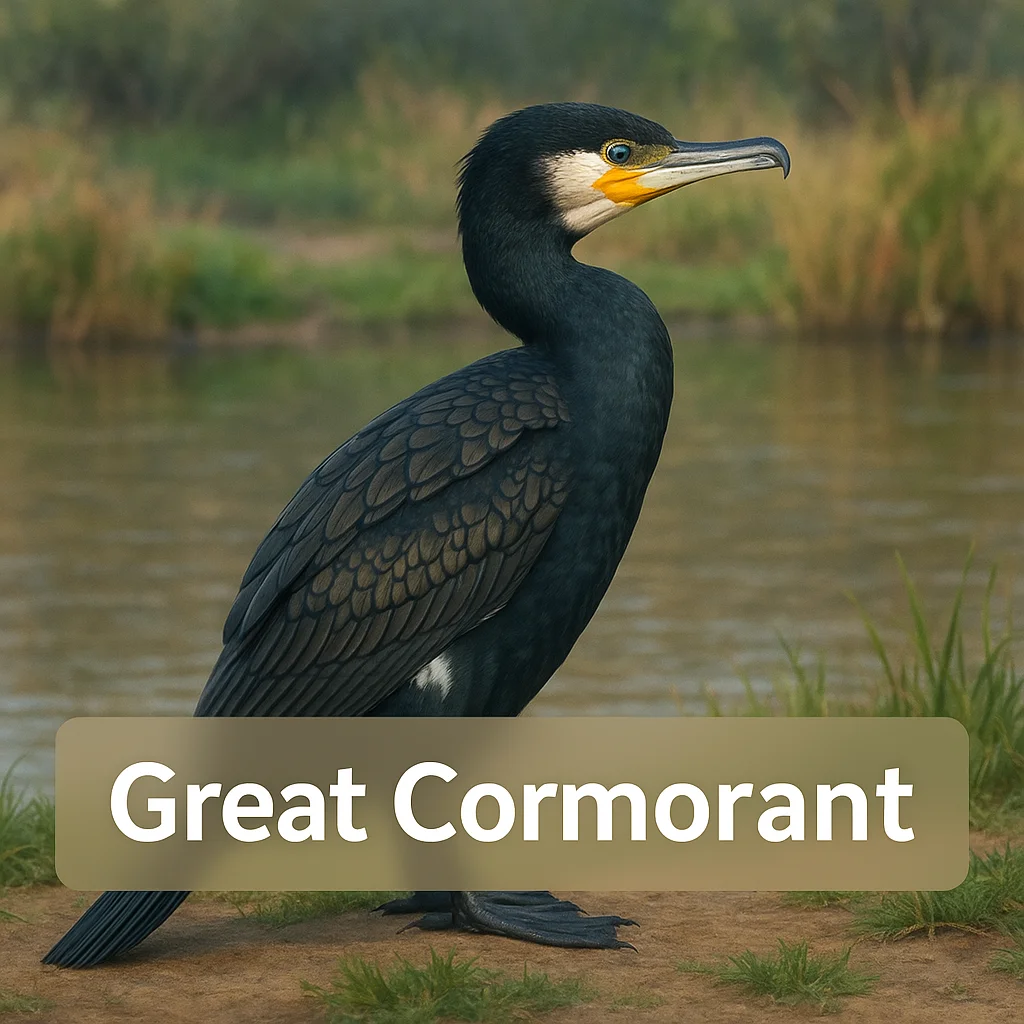
- Common name(s): Great Cormorant, Black Cormorant
- Scientific name: Phalacrocorax carbo
- Animal type: Bird
- Typical adult size: 80–100 cm in length; wingspan up to 160 cm
- Typical lifespan: 7–15 years in the wild
- Diet type: Carnivore; predominantly fish
- Activity pattern: Diurnal
- Social structure: Often forms colonies, especially during breeding
- Speed / movement highlights: Excellent diver; swims using feet
- Intelligence/learning: Capable of learning and adapting feeding strategies
- Primary habitats: Coastal areas, lakes, rivers
- Geographic range: Found on all continents except South America and Antarctica
- Predators/threats: Birds of prey, foxes; human disturbances
- Conservation status: Least Concern, but varies by region
🔍 Identification & Appearance
The Great Cormorant is easily recognizable by its large, black body and prominent hooked bill. Adults have a glossy black plumage with a greenish or bluish sheen, while the face and throat are white during the breeding season.
- Body shape and silhouette: Large and robust with a long neck and stout bill
- Key colors/patterns: Black with a metallic sheen; white facial patch during breeding
- Distinctive features: Hooked bill and webbed feet
- Tracks, scat, or other field signs: Webbed footmarks near water edges
- Common look-alikes: Often mistaken for other cormorant species; differentiate by size and throat markings
- Top ID Tips
- Look for large size and robust build
- Notice the metallic sheen on feathers
- Check for white patch on face during breeding
- Observe the hooked bill shape
- Locate in aquatic environments
- Look for diving behavior
🧱 Body Structure & Physical Adaptations
The Great Cormorant has a body designed for efficient diving and swimming. The bird's webbed feet propel it underwater, while its hooked bill aids in capturing slippery prey.
- Build and proportions: Robust, with a long neck and body suited to diving
- Beak adaptation: Hooked bill for catching fish
- Wings and feet: Webbed feet for propulsion; wings for short bursts of flight
- Sensory strengths: Excellent eyesight for underwater hunting
- Key Adaptations
- Streamlined body for diving
- Webbed feet enhance swimming speed
- Sharp bill for grasping prey
- Dense plumage for temperature regulation
- Keen eyesight in low-light water conditions
- Ability to dry feathers after diving
🌍 Range & Distribution
The Great Cormorant has a wide distribution, inhabiting coastal and inland waters across several continents. It is mainly found in Europe, Asia, Africa, and Australia, but its presence in North America is limited.
- Continents/regions: Europe, Asia, Africa, Australia
- Elevation range: Sea level to lakes at moderate elevations
- Migration: Some populations are migratory, moving south in winter months
- Where You Might Find It
- Coastal cliffs and beaches
- Inland reservoirs and large lakes
- Estuaries and river banks
- Wetlands with abundant fish
- Temperate zones during summer
🏞️ Habitat & Shelter
Great Cormorants prefer aquatic habitats rich in fish. They nest in colonies on cliffs, trees, or artificial structures. Seasonal changes influence their distribution, prompting migrations to suitable winter habitats where food remains accessible.
Understanding their habitat preferences aids in conserving suitable environments, which is critical for maintaining their populations.
🧭 Behavior & Ecology
Great Cormorants are primarily diurnal, spending their days foraging and resting. They communicate with vocalizations and physical displays. As apex predators, they control fish populations, while being prey to larger birds and mammals.
- Behavior Highlights
- Forms large breeding colonies
- Social outside of breeding season
- Engages in wing-drying postures
- Displays territorial behavior during nesting
- Relies heavily on vocalizations
- Serves as a bioindicator for aquatic ecosystems
👥 Social Life & Group Dynamics
The Great Cormorant exhibits both solitary and group behaviors. During the breeding season, they form dense colonies, with sizes varying based on habitat capacity. Cooperation is observed in defense and alarm signaling, with conflicts resolved through displays rather than physical altercations.
- Social Structure Notes
- Breeding colonies can be surprisingly large
- Flat hierarchy based on matriarchal access to nesting sites
- Pair bonds are seasonal
- Communication plays a role in reducing conflicts
- Participate in group defense strategies against predators
🍽️ Diet, Prey & Predators
As a carnivore, the Great Cormorant primarily feeds on a variety of fish, employing its diving and swimming skills to secure meals. In different habitats, their diet may occasionally include amphibians and crustaceans. Natural predators include birds of prey, while human activities pose significant challenges.
- Feeding Notes
- Consumes fish ranging from small fry to moderate size
- Adapts diet seasonally to prey availability
- Diving times reflect feeding intensity
- Swallow prey whole due to efficient digestive system
- Controls fish population, preventing overpopulation
🦌 Hunting, Foraging & Movement
The Great Cormorant is known for its efficient diving technique, powered by robust webbed feet. Though capable swimmers, they rely more on underwater prowess than speed. Flocking aids in coordinated foraging when conditions are favorable, but individual dives are common.
- Movement & Strategy
- Utilizes foot-propulsion underwater
- Exhibits strong diving capabilities up to 5 meters
- Patience is key during prey spotting
- Can fly moderate distances to find food
- Seasonal movement for optimal food sources
🧠 Intelligence & Senses
Great Cormorants display adaptive intelligence through their use of different hunting strategies and ability to exploit new environments. Their excellent vision underwater is a key sensory adaptation that aids in locating prey. While their social intelligence is evident during colony breeding, individual variances are observed.
- Notable Abilities
- Adaptive feeding techniques
- Excellent underwater vision
- Complex social communications
- Responsive to environmental changes
- Limited long-term memory yet effective learning capabilities
🪺 Reproduction, Pregnancy & Parenting
The breeding season for Great Cormorants varies regionally, often occurring in spring. Monogamous pairs form within colonies, with both sexes involved in nest building and egg incubation. Chicks are altricial, requiring significant parental investment before fledging.
- Reproduction Snapshot
- One breeding season annually
- Monogamous pair bonding
- Nest construction by both parents
- Incubation lasts 28–31 days
- Clutch size ranges from 3 to 5 eggs
- Chicks fledge around 6 weeks old
♀️♂️ Male vs Female Differences
Males and females are similar in appearance, although males are typically larger. Both contribute equally to nesting and feeding offspring, with behavior often indistinguishable in the wild. Such subtle sexual dimorphism makes visual distinction challenging.
- Sex Differences at a Glance
- Males generally larger and heavier
- Similar plumage patterns between sexes
- Shared responsibilities in chick rearing
- Equal territorial displays during courtship
🧬 Subspecies & Variation
The Great Cormorant comprises several subspecies with minor variations in size and plumage. Regional differences in appearance are minimal, often influenced by environmental conditions rather than genetic factors. Subspecies classification remains debated among ornithologists.
- Variation Notes
- Minor size variations among subspecies
- Plumage differences subtle, often seasonal
- Isolated populations show slight adaptations
- Debate exists regarding distinct subspecies classification
⚠️ Threats, Conservation & Human Interaction
Threats to Great Cormorants include habitat modification, pollution, and competition with fishermen. Conservation focus includes protecting habitat zones and ensuring sustainable fishing practices. Understanding human impact on these birds is crucial for coexistence.
- Responsible Notes
- Monitor water quality for species health
- Avoid disturbing nesting colonies
- Sustainable fishing reduces competition
- Preserve coastal and wetland habitats
- Educational outreach raises awareness of species' role
✨ Fun Facts & Unique Traits
- Great Cormorants can absorb sunlight through their spread wings, warming their bodies after dives.
- Known for their voracious appetite, they can eat more than half their weight in fish daily.
- Their feathers are not fully waterproof, aiding in swift dives but necessitating wing-drying.
- Unlike most birds, they have a reduced preen gland, which limits feather waterproofing.
- Great Cormorants have been historically used in traditional fishing methods in Asia.
- They can dive to impressive depths, typically seeking schools of fish.
📌 Summary
- Identified by their large, black bodies and hooked bills; seen in aquatic habitats worldwide
- Primarily found along coastlines and large inland waters
- Carnivorous diet focused on fish, with seasonal foraging patterns
- Predators include birds of prey and human-related threats
- Forms colonies for breeding; intricate social behaviors
- Reproduces annually, with both parents involved in chick care
- Adaptive diving and swimming capabilities highlight physical adaptations
- Known for excellent vision underwater and using sun to dry off