🦁 King Penguin
🧾 Quick Facts
The King Penguin is one of the largest species of penguins, renowned for its striking appearance and social behavior. It is predominantly found in the subantarctic regions.
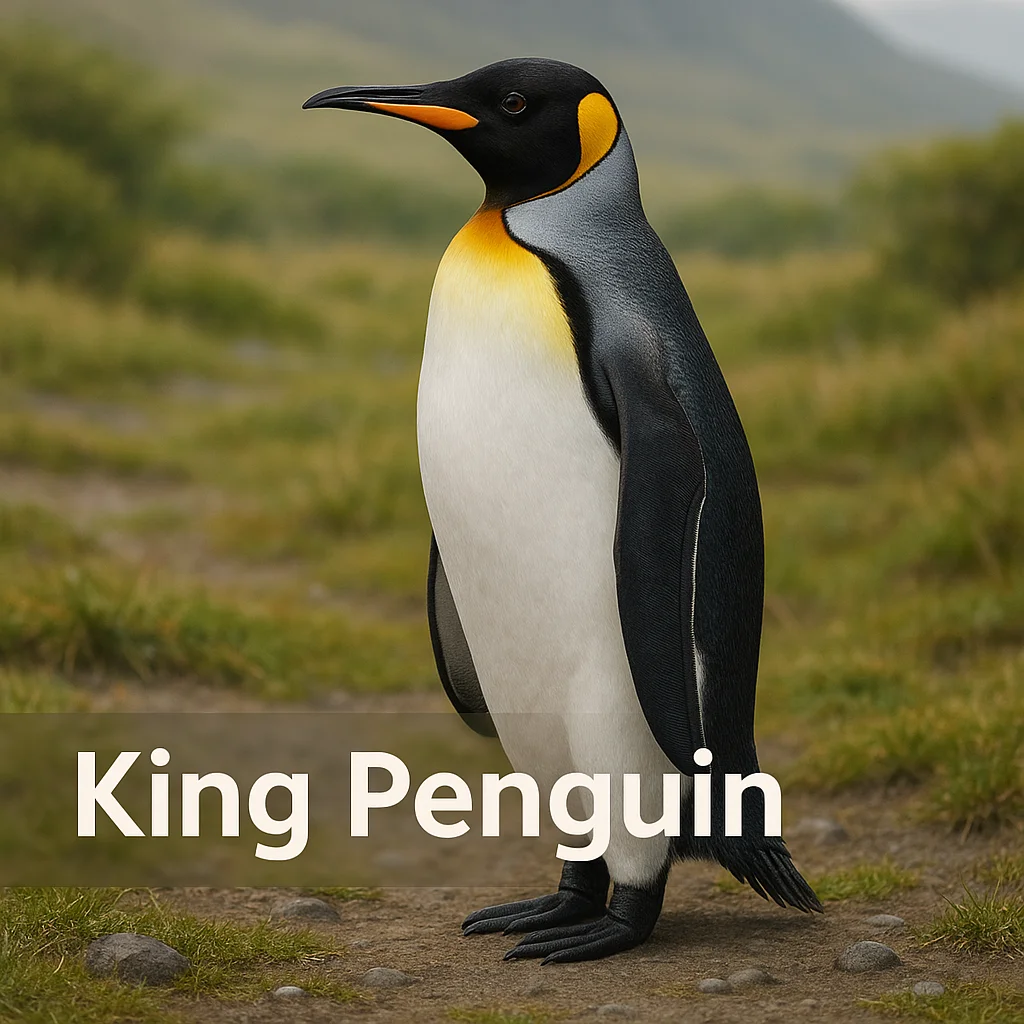
- Common name(s): King Penguin
- Scientific name: Aptenodytes patagonicus
- Animal type: Bird
- Typical adult size: 70-90 cm in height, 9-16 kg in weight
- Typical lifespan: 15-20 years in the wild
- Diet type: Carnivore; primarily feeds on fish and squid
- Activity pattern: Diurnal
- Social structure: Colonies consisting of thousands of individuals
- Speed / movement highlights: Agile swimmer; can reach speeds of 6-10 km/h underwater
- Intelligence/learning: Known for complex social behaviors and vocal communication
- Primary habitats: Subantarctic islands and ice-free areas
- Geographic range: Subantarctic regions, including parts of the South Atlantic and Indian Oceans
- Predators/threats: Natural predators include leopard seals and giant petrels; human threats include climate change and overfishing
- Conservation status: Least Concern, but threats vary by region
🔍 Identification & Appearance
The King Penguin is easily recognizable by its sleek, streamlined body and vibrant colors. It has a striking appearance characterized by a white belly, gray back, and a distinctive orange patch on the neck.
- Compact and torpedo-shaped body
- Sleek plumage with a white belly and ash-gray back
- Bright orange patches on the sides of the face and neck
- Long, narrow beak; black with an orange stripe
- Short, sturdy legs set far back on the body
- Look-alikes: Emperor Penguin, distinguishable by size and chest coloration
- Top ID Tips:
- Look for the striking orange neck patch
- Note the sleek, black-and-white body with grayish upperparts
- Observe the long, slender bill with orange markings
- Watch for elegant swimming movements
- Distinctive wriggling waddle on land
🧱 Body Structure & Physical Adaptations
King Penguins are highly adapted to their aquatic lifestyle. Their physical build and features ensure efficient swimming and survival in cold environments.
- Sleek, hydrodynamic body for swift swimming
- Strong flippers adapted for underwater propulsion
- Layered feathers for insulation against cold water
- Beak specialized for grasping slippery prey
- Webbed feet aid in swimming and maneuvering in water
- Exceptional vision adapted for dim underwater conditions
- Key Adaptations:
- Streamlined body reduces water resistance
- Thick plumage provides insulation
- Strong flippers act like wings for "flying" underwater
- Acute vision for spotting prey below the surface
- Efficient heat regulation through vascular adaptations
🌍 Range & Distribution
The King Penguin predominantly inhabits subantarctic islands, making their range unique among penguins. They are typically found on ice-free beaches and are well adapted to this environment.
- Found in subantarctic regions
- Commonly seen on islands like South Georgia and Crozet Islands
- Inhabits ice-free parts of the southern oceans
- Mostly stays close to coastal areas
- Some reports of northern colonization on the Falklands
- Where You Might Find It:
- South Georgia Island
- Crozet Archipelago
- Kerguelen Islands
- Heard Island
- Macquarie Island
🏞️ Habitat & Shelter
The King Penguin thrives on subantarctic islands, usually preferring areas that are devoid of snow and ice. They often gather in large colonies on sandy or rocky beaches.
- Prefers coastal areas and beaches for breeding
- Not typically found in dense ice or snow-covered regions
- Colony locations tend to offer shelter from predators
- Utilizes open ocean areas for feeding
- Seasonal changes affect food availability and distribution
🧭 Behavior & Ecology
The social nature of King Penguins is evident from their breeding colonies, where thousands of individuals gather. They engage in elaborate vocal and physical displays, forming a key part of their communication.
- Active during daylight, engages in social interactions
- Uses vocalizations for communication in colonies
- Regulates body temperature by huddling behavior
- Predation pressure affects colony structure and dynamics
- Integral part of marine food webs, as middle-trophic predators
- Behavior Highlights:
- Impressive group huddling to retain warmth
- Distinctive trumpeting calls for recognition
- Participates in synchronized diving
- Complex courtship displays and bonding rituals
- Vigilant behavior around natural predators
👥 Social Life & Group Dynamics
King Penguins are among the most social of all penguin species, forming large colonies during breeding season. Their social dynamics are complex, involving intricate displays and vocal exchanges.
- Form large colonies during breeding seasons
- Colonies can number from thousands to tens of thousands
- Monogamous pairs often remain together over multiple breeding seasons
- Strong social bonds within flocks
- Display tolerance and cooperation among colony members
- Social Structure Notes:
- Intricate social hierarchy within colonies
- Cooperative care behaviors observed in raising chicks
- Defensive strategies against predators in numbers
- Pair bonding can last several seasons
- Strong coordination within flocks while at sea
🍽️ Diet, Prey & Predators
As carnivores, King Penguins primarily consume marine life. Their diet includes fish and squid, which they skillfully catch during dives. They face danger from predators like leopard seals and orcas.
- Primarily eats fish and squid during foraging trips
- Dives for food in the open ocean, traveling significant distances
- Dive depths can reach up to 300 meters
- Ingests prey whole, stored in stomach for long periods
- May face predation by seals and large seabirds
- Feeding Notes:
- Highly skilled underwater hunters
- Capable of long-distance foraging trips
- Regurgitation of food to feed chicks
- Flexible diet depending on seasonal prey availability
- Complementary feeding strategies within groups
🦌 Hunting, Foraging & Movement
King Penguins are adept swimmers, hunting in the open ocean. They are capable of traveling substantial distances in pursuit of food, showcasing a blend of endurance and speed.
- Efficient swimmers using powerful flippers
- Dives can last up to 5 minutes
- Foraging dives are strategic, often near prey-rich zones
- Underwater agility facilitates prey capture
- Regular foraging expeditions extend over hundreds of kilometers
- Movement & Strategy:
- Efficient use of streamlined bodies for fast swimming
- Coordinated diving can reduce prey escape
- Strategic swarm formation while foraging
- Adaptive routes minimize energy expenditure
- High site fidelity to breeding grounds
🧠 Intelligence & Senses
King Penguins exhibit notable problem-solving abilities and social intelligence, especially in the complex setting of their colonies. Their senses, particularly vision and hearing, are crucial for both survival and communication.
- Acute vision both above and underwater
- Recognizes mate's call among thousands of penguins
- Social intelligence evident in colony dynamics
- Memory aids in long-distance migration returns
- Adaptability in foraging strategies
- Notable Abilities:
- Sound-based recognition in noisy colonies
- Strategic group movements to optimize hunting
- Heightened sensory skills for efficient navigation
- Complex social learning within colonies
- Use of specific call sequences for identification
🪺 Reproduction, Pregnancy & Parenting
King Penguins have a balanced reproductive strategy, with a lengthy breeding cycle that includes shared parenting duties. Their social structure facilitates effective chick rearing.
- A year-long breeding cycle
- Typically lay a single egg per cycle
- Both parents share incubation duties
- Chicks hatch after around 54 days
- Chicks stay in crèches for warmth and protection
- Reproduction Snapshot:
- Monogamous pairs return to the same breeding sites
- Extended parental care extends to chick readiness
- Both parents participate in feeding offspring
- Colonies coordinate nursery-like crèches for chick safety
- Adaptable breeding cycle in response to environmental variables
♀️♂️ Male vs Female Differences
Male and female King Penguins are similar in appearance, although subtle differences exist regarding their roles and minor physical traits.
- Sexes are visually similar; males are slightly larger
- Both exhibit similar vocal and physical displays during courting
- Shared parental roles reduce sex-specific differentiation
- Dominance may see males initiate breeding territory selections
- No significant sexual dimorphism in coloration
- Sex Differences at a Glance:
- Males may be slightly heavier and larger
- Both sexes share similar breeding and parenting duties
- Territory selection might see male initiative
- No distinct plumage differentiation between sexes
- Similar vocal range in communication
🧬 Subspecies & Variation
There are no recognized subspecies of the King Penguin, although some variation in size and weight can occur based on geographic location or environmental factors.
- Considered as a single species with minimal variations
- Minor size variations based on latitude and nutrition
- Adaptations aligned broadly with local climatic conditions
- Some size and weight inconsistency related to diet availability
- Considered uniform due to lack of geographical barriers
- Variation Notes:
- Uniform appearance with consistent coloring
- Minor localized differences in size
- No formally recognized subspecies
- Environmental conditions impact size slightly
- Wider adaptability contributes to uniformity
⚠️ Threats, Conservation & Human Interaction
The King Penguin's thriving populations face natural and anthropogenic threats. Conservation measures are crucial for their sustained presence in various regions.
- Climate change impacts prey availability and breeding habitats
- Overfishing threatens food sources like fish and squid
- Oil spills and marine pollution pose regional threats
- Pursued by natural predators, including seals and large birds
- Typically, unaffected by human contact in isolated habitats
- Responsible Notes:
- Respect wildlife and maintain distance
- Support sustainable fishing practices
- Reduce pollution to minimize marine impacts
- Promote conservation efforts for natural habitats
- Avoid disruption during the breeding season
✨ Fun Facts & Unique Traits
- King Penguins are the second-largest species of penguin, following the Emperor Penguin.
- They have a unique breeding cycle that spans over a year, longer than most penguins.
- These penguins possess a specialized protein in their blood that allows them to better withstand cold temperatures.
- King Penguins are known for their colorful throat patches, a unique identifier amidst their flock.
- They can dive deeper than many other penguin species, reaching up to 300 meters.
- Their distinct calls help parents and chicks locate each other in large colonies.
- King Penguins can travel over 500 kilometers from their colonies to forage for food.
- One of the rare penguins that incubates eggs on their feet, under a fold of skin.
- They follow a "bi-annual" nesting system, laying eggs twice every three years.
- Chicks are left in communal "crèches" for protection while adults fish.
📌 Summary
- Identified by distinctive orange throat patches
- Inhabit subantarctic islands with ice-free beaches
- Forages on fish, squid, and can dive over 300 meters
- Faces predators like leopard seals and large birds
- Forms large colonies for breeding with cooperative care
- Monogamous, with unique prolonged breeding cycles
- Adapted for efficient swimming and cold temperature resistance
- Affected by climate impacts and marine resource changes
- Known for complex social behaviors and vocal communications