🦁 Wandering Albatross
🧾 Quick Facts
The Wandering Albatross, known for its massive wingspan, is a remarkable seabird soaring over the open oceans. Distinguished by its graceful gliding, this bird is a symbol of freedom and endurance in the avian world.
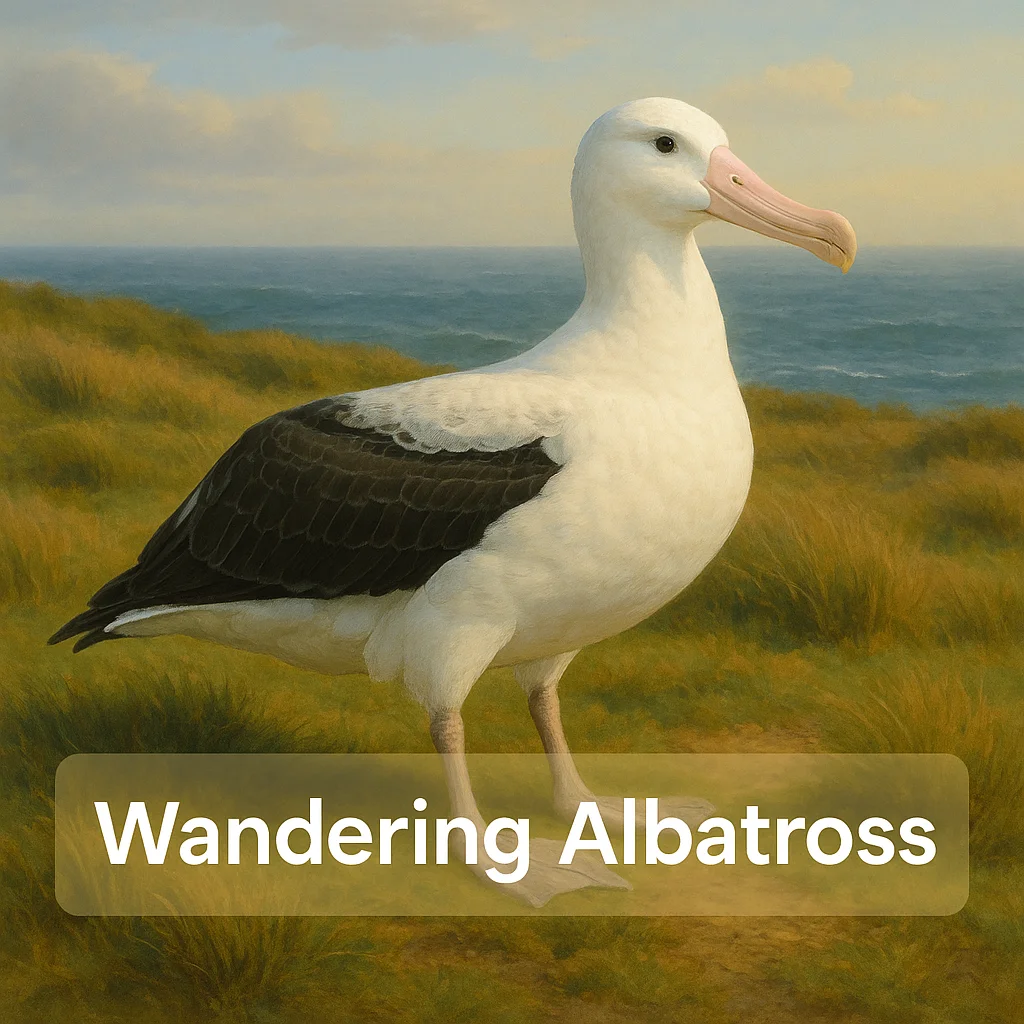
- Common name(s): Wandering Albatross
- Scientific name: Diomedea exulans
- Animal type: Bird
- Typical adult size: Wingspan ranges 2.5 to 3.5 meters, weighing 6 to 12 kilograms
- Typical lifespan: 40 to 50 years in the wild
- Diet type: Carnivore; feeds on squid, fish, and crustaceans
- Activity pattern: Diurnal
- Social structure: Typically solitary or found in pairs
- Speed / movement highlights: Glides effortlessly with minimal wing flapping
- Intelligence/learning: Display remarkable navigational skills; relies on environmental cues
- Primary habitats: Open ocean
- Geographic range: Southern Ocean, circumnavigating Antarctica
- Predators/threats: Giant petrels, skuas; human threats include longline fishing
- Conservation status: Vulnerable
🔍 Identification & Appearance
The Wandering Albatross is easily recognized by its immense wingspan and snow-white plumage accented with wingtips of black. As they age, their wings become predominantly white, while juveniles feature more dark feathers.
- Large body with extraordinarily long, narrow wings
- White plumage with black wingtips that diminish as they mature
- Pinkish beak and feet
- Straight bill with a slight hook on the end
- Graceful appearance when gliding across the sea
- Can be confused with other large albatrosses but check for wingspan and plumage variations
- No field sign like tracks or scat, as they seldom land apart from nesting
- Different from similar species by its lighter-colored wings in adults
- Top ID Tips
- Look for the largest wingspan among seabirds
- Identify by clean white body contrasting with black-tipped wings
- Observe the curved tip of their pink beak
- Notice the elegant, efficient gliding flight
- Distinctive white back in mature adults
- Young birds have more mottled or dark plumage
🧱 Body Structure & Physical Adaptations
The Wandering Albatross is uniquely adapted for life on the open seas. Its physical attributes enhance its survival and efficiency in long-distance travel.
- Sleek, streamlined body optimized for gliding
- Massive wingspan allowing dynamic soaring over vast distances
- Hooked bill for effective grasping and holding of slippery prey
- Strong muscular legs; though seldom used as they rarely land
- Exceptional vision aiding in spotting food from great heights
- Lacks strong olfactory senses as feeding relies on sight
- Adapted to minimize energy expenditure during flight
- Adults develop more efficient, lighter plumage as they age
- Key Adaptations
- Huge wingspan for energy-efficient gliding
- Long, straight bill perfect for catching ocean prey
- Specialized tube-nostrils for salt excretion via saline concentrates
- Robust legs adapted for strong take-offs and landings
- Keen eyesight for effective prey detection
- Soft plumage aids in body temperature regulation
🌍 Range & Distribution
The Wandering Albatross primarily inhabits the Southern Ocean, favoring the open and often unforgiving waters of the Antarctic and sub-Antarctic regions.
- Found surrounding the icy waters of Antarctica
- Breeding colonies on remote islands such as South Georgia, Crozet Islands
- Wanders vast oceanic expanses outside of breeding season
- Can be seen across hemispheres, particularly around the Southern Ocean
- Migratory routes cover massive ocean areas without touching land
- Where You Might Find It
- Southern Ocean during both breeding and non-breeding seasons
- Islands like Crozet and Kerguelen for nesting
- Spotted occasionally off the coasts of South Africa and New Zealand
- Popular on pelagic bird-watching tours
- Regularly far from any land except during breeding
- Watch from vessels traversing across southern maritime zones
🏞️ Habitat & Shelter
The Wandering Albatross thrives in open ocean environments, a testament to its incredible adaptability and endurance in maritime life.
- Prefers expanses of the Southern Ocean and subantarctic waters
- Breeds on remote islands with steep, windy cliffs offering launch sites
- Nests are large, grassy mounds that offer wind protection
- Primarily at sea throughout the year, settling temporarily only for reproduction
- Adapts behaviorally to seasonal weather changes
- Knowledge of habitat supports understanding its adaptability and survival needs
🧭 Behavior & Ecology
As symbols of perseverance, Wandering Albatrosses exhibit fascinating behavior that plays a crucial role in their ecosystem dynamics.
- Long periods spent at sea; enormous daily distances covered
- Vocal and visual displays during mating rituals
- Plays a key role in the oceanic food chain as a predator
- Occasional scavenging, following fishing vessels
- Minimal ground-time, emphasizing airborne lifestyle
- Contribute to nutrient cycles via guano deposits on breeding islands
- Behavior Highlights
- Renowned for perpetually gliding over oceans
- Interacts minimally with humans and other terrestrial animals
- Efficient at utilizing atmospheric currents, saving energy
- Solitary for major parts of the lifespan except in breeding season
- Silent at sea, vocal primarily during mating
👥 Social Life & Group Dynamics
Wandering Albatrosses are largely solitary seabirds, but complexity arises within their social interactions during reproductive periods.
- Mainly solitary apart from breeding partners
- Strong pair bonds formed, often for life
- Small colony groups during breeding season
- Displays minimal aggressive behavior, highly tolerant during pairing
- Both parents involved in chick-rearing
- Occasional disputes over nesting sites amid large colonies
- Social Structure Notes
- Primarily solitary except for mating and chick-rearing periods
- Exhibits impressive lifelong devotion to a single partner
- Colony gatherings visible on small, isolated islands
- Engages in cooperative parental care
- Peaceful colonies with strongly knit pairs
🍽️ Diet, Prey & Predators
Wandering Albatrosses have a carnivorous diet primarily focused on the rich marine life of the Southern Oceans.
- Dines on squid, small fish, and krill
- Might opportunistically feed on refuse from vessels
- Faces threat from larger birds like giant petrels
- Commits hours in flight searching for prey on the ocean surface
- Anti-predator strategy includes nesting on isolated islands
- Consistent feeding habits ensure energy reserves for prolonged flights
- Feeding Notes
- Hinges diet largely on squid and small fish
- Forages efficiently utilizing sharp eyesight
- Captures prey with agile dives and swift pick-ups
- Scavenges opportunistically near ships
- Benefitting from extended digestive tracts for efficient digestion
🦌 Hunting, Foraging & Movement
The magnificent flying techniques of the Wandering Albatross allow it to cover extensive distances with minimal exertion, truly mastering the art of flight.
- Primarily flies using dynamic soaring, minimizing energy use
- Flaps wings infrequently, gliding vast distances
- Incredible endurance over open seas; remarkable non-stop travel capacity
- Careful foraging times to align with prey availability
- Navigation reliant on environmental markers and possibly innate senses
- No known set migration route but vast, nomadic range
- Movement & Strategy
- Employed dynamic soaring utilizes wind patterns
- Prefers long, trans-oceanic journeys
- Particularly skilled at locating shrinking islands to rest during storms
- Occasional descents for prey, swooping down with precision
- Complex navigation likely a combination of learned and genetic factors
🧠 Intelligence & Senses
While not heralded as problem solvers, Wandering Albatrosses display remarkable navigational abilities and sensory adaptation for ocean life.
- Solid navigation skills, presumed mixture of natural instinct and experience
- Superb vision ideal for spotting prey correctly from high up
- Limited evidence of tool use or complex problem solving
- Basic learning of ocean currents and wind patterns improves with age
- Sensitive to changes in barometric pressure, predicting weather shifts
- Notable Abilities
- Exceptional eyesight for hunt precision
- Memorizes oceanic currents, aiding efficient foraging
- Adapted beak for diverse prey suite
- Long-term memory on breeding routes
- Heightened sensitivity to atmospheric changes
🪺 Reproduction, Pregnancy & Parenting
Breeding is a significant life event for Wandering Albatrosses, with both parents investing heavily in parental care and fostering strong partnerships.
- Breeding season focused around two-year intervals
- Engages in a lifelong monogamous mating system
- Single egg per breeding cycle with incubation lasting about 80 days
- Highly altricial young, need significant post-hatch care
- Both parents share incubation and chick feeding duties
- Chicks fledge at about nine months old
- Reproduction Snapshot
- Lifelong monogamy once pair bonds are established
- Single large egg per breeding attempt
- Prolonged adolescent phase for chick learning
- Colony breeding provides shared safety and communal vigilance
- Extensive parental commitment shown by both sexes
♀️♂️ Male vs Female Differences
The differences between male and female Wandering Albatrosses are subtle, primarily witnessed in size and rarely in behavior.
- Males typically larger with broader wingspan than females
- Monomorphic plumage, negligible sexual dimorphism visually
- Slight variance in vocalization pitch during mating rituals
- Shared responsibilities in nesting and chick-rearing
- Sex Differences at a Glance
- Males slightly larger and robust
- Females may choose nesting sites
- No significant difference in color patterns
- Equally invested in parenting tasks
- Both engage vocally for pairing communication
🧬 Subspecies & Variation
The classification of Wandering Albatross subspecies is debated, with subtle differences primarily in size and geographic range being points of distinction.
- Subspecies suggestions include areas of breeding isolation
- Observed size variance across populations indicates adaptation dimensions
- Regional adaptations could evolve due to host island environments
- Debate exists over subspecies legitimacy, due to overlapping character traits
- Possible existence of genetic but visually indistinct differentiation
- Variation Notes
- Plausible subspecies classification in distinct island regions
- Minimal physical variation in plumage despite geographic isolation
- Adaptable feeding strategies linked to resource availability
- Challenges in distinct subcategorization due to mobility
- Potential genetic drift as contributing to subspecies debates
⚠️ Threats, Conservation & Human Interaction
The enduring Wandering Albatross faces various challenges, both natural and human-induced, necessitating mindful conservation efforts to secure its future.
- Vulnerable to longline fishing which results in accidental bycatch
- Breeding colony disruption from introduced predators like rats and cats
- Environmental degradation impacting food availability
- Impact from climate change altering migratory and foraging patterns
- Efforts involve tracking devices for better understanding ocean movements
- Responsible Notes
- Promote sustainable marine practices mitigating bycatch loss
- Conservation programs on breeding islands to prevent invasive species
- Safe sea disposal methods reduce plastic ingestion risks
- Preservation of feeding grounds must be a global responsibility
- Monitoring climate impacts through scientific datasets
✨ Fun Facts & Unique Traits
- The Wandering Albatross has the longest wingspan of any living bird
- Capable of sleep during flight, resting one hemisphere of their brain
- Named 'Wandering' due to their extensive migratory treks
- Uses their nasal passages to excrete salty seawater
- Once believed to live over 60 years; proving greater longevity
- Can circumnavigate the Southern Hemisphere in 46 days
- Pioneering studies on wing aerodynamics inspired modern aviation
📌 Summary
- Renowned for largest wingspan and distinct white-black plumage
- Habitats span the vast Southern Ocean, featuring isolated islands for breeding
- Nomadic, trans-oceanic distribution without permanent land residence
- Primarily carnivorous diet focused on squid and fish
- Seldom encounters predators when far at sea, but faces human threats
- Largely solitary lifestyle with distinctive long-term pair bonding
- Parental cooperation is notable in long period of chick nurturing
- Marvelous adaptations for energy-efficient gliding and high endurance
- Conservation crucial to counter fishing and climate impacts
- Remarkable for their incredible lifespan, flight tolerance, and global journeys