🦁 Clouded Leopard
🧾 Quick Facts
The clouded leopard, often referred to by its scientific name Neofelis nebulosa, is a mesmerizingly beautiful feline native to the forests of Southeast Asia. As a part of the family Felidae, it boasts unique physical and behavioral traits that distinguish it from other big cats. Recognized for its distinctive cloud-like markings, this elusive predator is an important species that highlights the rich biodiversity of its native habitats.
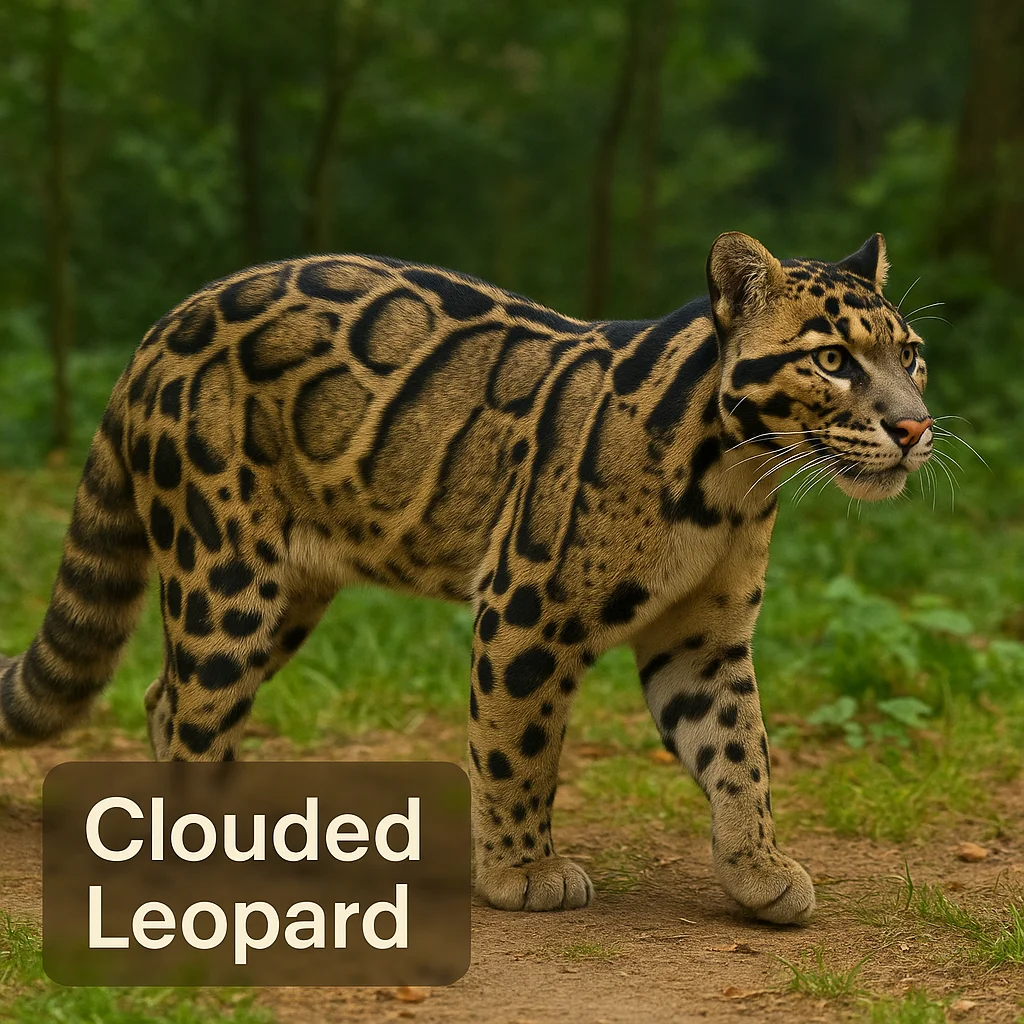
- Common name(s): Clouded Leopard
- Scientific name: Neofelis nebulosa
- Animal type: Mammal
- Typical adult size: 2–3 feet long (65–95 cm), tail adds another 2.5–3 feet (60–91 cm); weight 25–51 pounds (11–23 kg)
- Typical lifespan: 11–17 years in the wild; up to 20 years in captivity
- Diet type: Carnivore; mainly deer, pigs, birds, and monkeys
- Activity pattern: Primarily nocturnal, some crepuscular activity
- Social structure: Solitary, except during breeding
- Speed / movement highlights: Agile tree climber, capable of hanging upside down from branches
- Intelligence/learning: Highly adapted for stealth and arboreal life
- Primary habitats: Forests, including tropical and subtropical rainforests
- Geographic range: Southeast Asia, including Nepal, Bhutan, Myanmar, Thailand, Malaysia, and Sumatra
- Predators/threats: Habitat loss, poaching, and conflict with humans
- Conservation status: Vulnerable
🔍 Identification & Appearance
The clouded leopard is characterized by its slender build and long, bushy tail which makes up almost the same length as its body. Its coat is short and ranges in color from dark grey to ochre, covered with large, cloud-like spots outlined in black, which gives this animal its name. These spots serve as excellent camouflage amidst the dense trees.
- The body is lithe and adept for climbing, resembling a cross between a large cat and a panther.
- Coat pattern is unique to each individual, aiding in identification.
- Prominent black stripes run along the midline of their head and back.
- Long canine teeth almost as long as those of a tiger.
- Paws equipped with retractable claws; ideal for gripping branches.
- Tracks are rounded with retractable claw marks typically absent.
🧱 Body Structure & Physical Adaptations
The clouded leopard's body is perfectly designed for life in the trees. It has a low-slung, elongated body, short limbs for balance, and a tail used for counterbalance while moving through the canopy. Its powerful jaw and exceptionally long canine teeth allow it to effectively catch and hold onto prey much larger than itself.
- Flexible ankle joints enable it to climb head-first down trees.
- Robust build with a large shoulder-blade structure for powerful jumps.
- Rear limbs are longer, aiding in leaping and climbing.
- Keen eyesight and acute hearing for nocturnal hunting.
- Distinctive cloud-like spotted fur for camouflage.
🌍 Range & Distribution
Clouded leopards are found across Southeast Asia, from the foothills of the Himalayas through Southeast Asia to China. Their presence is recorded in lush, tropical, and subtropical rainforests, evergreen forests, and mixed deciduous forests. They mostly inhabit regions between 3,000 to 9,800 feet elevation but can be found at lower altitudes as well.
- This species is primarily distributed across the Indian subcontinent and Southeast Asia.
- Spotted in dense forest regions and occasionally in grassland margins.
- Resident animal, primarily stationary though capable of long-distance movement if needed.
- Most sightings occur in protected areas like national parks and wildlife reserves.
- Elevation range spans lowland rainforests up to mountainous regions.
🏞️ Habitat & Shelter
The clouded leopard thrives in dense forests, which offer it the highest availability of prey and cover. These cats are excellent climbers, often residing in tree canopies for shelter and safety. During extreme weather or the dry season, they might descend to lower areas where prey is more abundant.
Changes in habitat due to logging and human encroachment continue to threaten their existence. Understanding their habitat is crucial for conservation efforts, as it directly influences their food resources, breeding patterns, and survival strategies.
🧭 Behavior & Ecology
The clouded leopard spends much of its life alone, only coming together during the mating season. Its solitary nature is attributed to its predatory and territorial behaviors. They mark their territory with unique vocal sounds and scent marks.
In an ecosystem, they're considered apex predators playing a crucial role in maintaining the balance by managing prey populations such as deer and birds. However, they avoid competition by being primarily arboreal, reducing direct confrontations with terestrial predators.
- Primarily nocturnal, active mostly at dusk and dawn.
- Climbs trees to rest and avoid predators.
- Uses vocal calls and scent marks for communication.
- Helps in maintaining healthy prey populations.
- Intraspecies aggression typically avoided due to secretive behavior.
👥 Social Life & Group Dynamics
Clouded leopards are predominantly solitary animals. They may occasionally be spotted in pairs during the mating season. This solitary lifestyle reduces competition for resources. After mating, females assume sole responsibility for raising the young, suggesting a high degree of maternal investment.
- Singles—interact briefly during mating.
- Otherwise solitary, with defined but overlapping home ranges.
- Females raise cubs exclusively with no male assistance.
- No clear dominance hierarchies as seen in pack animals.
🍽️ Diet, Prey & Predators
The clouded leopard is a carnivore with a diet primarily consisting of mammals such as deer, monkeys, and birds. It hunts both in the trees and on the ground, taking advantage of its arboreal abilities to surprise its prey. While adults face few threats, young clouds may fall prey to larger carnivores and should avoid human settlements.
- Prefer medium-sized mammals but are opportunistic hunters.
- Efficient hunters using stealth and swift attacks.
- Defends against predators using cryptic coloration and climbing ability.
- Human encroachment and habitat destruction pose significant threats.
🦌 Hunting, Foraging & Movement
The clouded leopard is renowned for its arboreal prowess. This feline can climb head first down trees and hang upside down from branches due to its rotating ankle joints. As ambush predators, clouded leopards sit in wait within the foliage, dropping down upon unsuspecting prey.
- Capable climbers with strong muscular build for gripping and moving.
- Quiet stalkers using cover and shadows.
- Flexible roaming patterns, adapted for dense forests.
- Home range fluctuates with prey availability.
🧠 Intelligence & Senses
The clouded leopard boasts sharp senses, including keen eyesight, excellent hearing, and a strong sense of smell. These sensory adaptations are crucial for its nocturnal hunting lifestyle. Though not much is known about their problem-solving abilities, leopards exhibit a strong capacity for learning in captive conditions.
- Exceptionally sharp night vision for identifying prey in low light.
- Adept at using terrain and vegetation strategically.
- Limited research on complex behaviors, due to elusive nature.
🪺 Reproduction, Pregnancy & Parenting
Clouded leopards do not have a specific mating season, and mating can occur at any time of the year. The gestation period lasts around 85 to 93 days. Litter sizes typically range from one to five cubs. In the wild, mothers rear the offspring alone. Cubs are born blind and require parental care, developing independence months after birth.
- Mating system remains flexible, favoring promiscuity.
- Cubs are born altricial, dependent on their mothers for several months.
- Parental care solely provided by the female, no male involvement noted.
♀️♂️ Male vs Female Differences
Physical and behavioral differences between male and female clouded leopards are subtle. Males tend to be slightly larger and more robust than females, which may be beneficial in territorial dominance and competition during breeding season. However, these differences are not as pronounced as in other big cat species.
- Males are generally larger, averaging 20% to 25% heavier.
- Females exhibit more solitary behavior, especially when nurturing young.
- Subtle differences in vocalization patterns between sexes.
🧬 Subspecies & Variation
The clouded leopard previously grouped as a single species has been classified into distinct subspecies, which vary in terms of size, coat color, and pattern. There is ongoing debate over precise classification and potential subdivisions into separate species.
- Two major classifications: mainland clouded leopards and Sunda clouded leopards.
- Island leopards (e.g., Bornean) show divergent traits influenced by isolation.
- Potential geographic variants due to distinct biomes across range.
⚠️ Threats, Conservation & Human Interaction
The clouded leopard faces numerous threats, primarily from habitat loss due to deforestation and human encroachment, as well as illegal poaching. They are listed as vulnerable, necessitating conservation initiatives focused on habitat preservation and anti-poaching efforts. Human-leopard conflict is less frequent compared to other big cats, though still present.
- Conservation efforts include habitat protection and breeding programs.
- Local education initiatives focus on coexistence strategies.
- Protected areas and reserves vital for population stability.
✨ Fun Facts & Unique Traits
- The clouded leopard's long canines resemble saber-tooth cats, earning it the nickname "modern-day sabre-tooth."
- They are one of the best climbers amongst cat species, able to swing like a monkey.
- Despite being termed a "leopard," it is not closely related to true leopards.
- Its unique, cloud-patterned fur allows for excellent camouflage.
- Exhibits rotational ankle joints enabling descent down trees head-first.
📌 Summary
- The clouded leopard, a unique arboreal feline, is native to Southeast Asia.
- Measuring 2-3 feet long, its bushy tail aids in balancing while climbing.
- Resides in tropical rainforests with a diet primarily of mammals and birds.
- Their cloud-like markings and arboreal prowess distinguish them in their habitat.
- Vulnerable species due to habitat loss but are key to maintaining prey populations.
- Predominantly solitary except for breeding and nurturing young.
- Distinctive adaptations include long canines and flexible ankle joints for climbing.
- Conservation efforts are crucial to preventing further population decline.